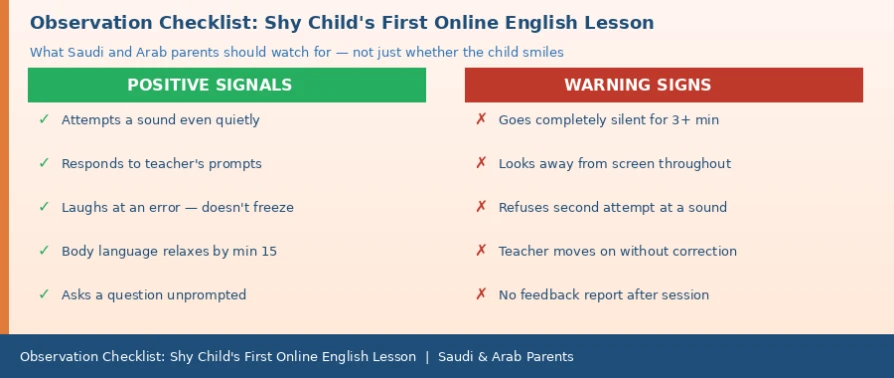
Watching your shy daughter sit down for her first one-on-one online English lesson brings a specific kind of parental anxiety. Will she freeze? Will she refuse to speak? Will the teacher know how to handle it? The instinct is to measure success by whether she smiles or whether she speaks at all. Those things matter, but they are not the most informative things to watch.
This checklist is for Saudi and Arab parents observing a young learner who hesitates to speak English. It covers what positive engagement looks like for a shy child in session one, what warning signs suggest the teacher is not the right match, and how confidence typically develops across the first twenty sessions. It does not cover selective mutism or clinical anxiety, which require professional assessment.
Why Shyness in English Is Not the Same as Language Inability
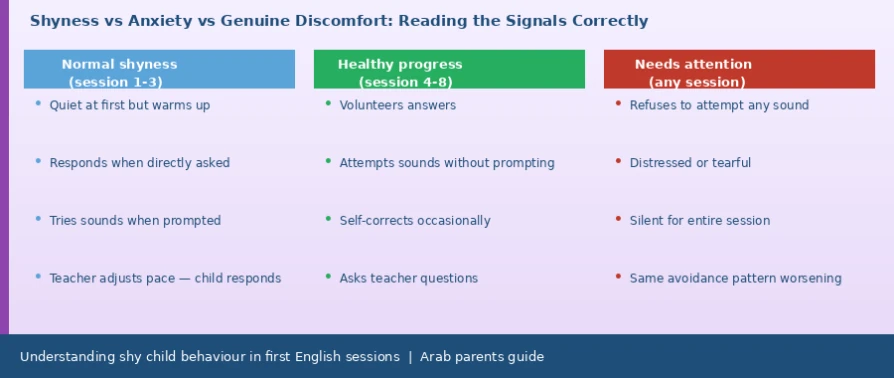
A child who speaks Arabic fluently and goes silent in English is not demonstrating a language problem. She is demonstrating a confidence problem. The two require different responses. Pushing a shy child to perform in front of peers, or correcting her bluntly when she attempts a sound, reinforces the association between English and risk. The right first-session goal is not accuracy. It is one non-catastrophic experience with speaking.
Shy children often know more English than they show. The gap is not vocabulary or grammar. It is the courage to produce language in front of another person. A teacher who understands this creates low-stakes opportunities. A teacher who pushes for output before trust is established accelerates avoidance, not progress.
What to Observe During the First Session
-
Does the child respond, even quietly, when the teacher asks a direct question?
-
Does the teacher wait at least 8 to 10 seconds before filling a silence?
-
Does the teacher affirm the attempt before naming what to correct?
-
Is the child’s body language visibly more relaxed by the second half of the session?
-
Does the teacher demonstrate sounds herself before asking the child to produce them?
-
If the child makes an error, does the teacher treat it as a normal part of learning?
A child who whispers a response in session one but is genuinely attempting has made meaningful progress. Do not mistake volume for progress. The attempt is what counts at this stage.
The 5-Stage Confidence Arc for Shy Children
Confidence in speaking English does not arrive all at once. It comes in stages, and each stage has specific observable signals. Parents who know the stages can distinguish between a programme that is working slowly and one that is not working at all.
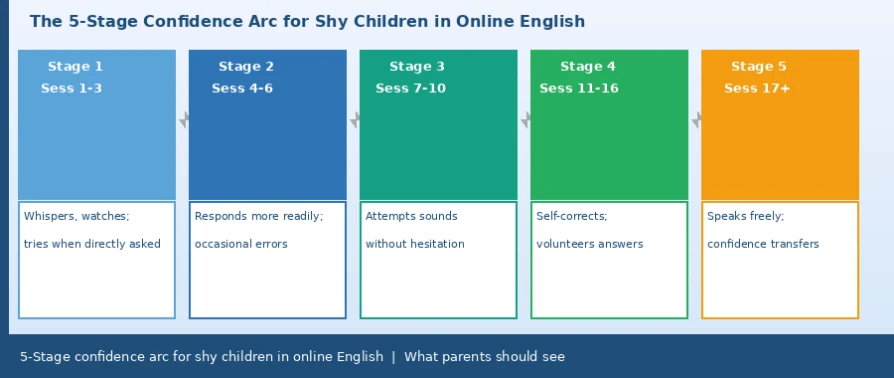
If your child is still in Stage 1 after ten sessions — whispers and withdraws, never attempts unprompted — the issue is likely the teacher or the format rather than the child. One-on-one sessions remove the peer audience, which eliminates the most common reason for avoidance. If avoidance persists in a one-on-one setting, ask whether the teacher has specific experience with shy learners and whether her correction approach prioritises warmth before accuracy.
Observation Checklist: What to Watch in Session 1
| What to observe | Green signal | Warning sign |
| Child attempts a sound | Yes, even quietly | Complete silence for 10+ minutes |
| Teacher response to silence | Waits patiently, then invites | Fills silence immediately or pushes |
| Correction style | Affirms first, then corrects specifically | ’Wrong’ or ‘try again’ with no guidance |
| Child body language at minute 20 | Some relaxation visible | Same tension as minute 1 |
| Second attempt at sounds | Teacher gets a repeat attempt | Session moves on without repeat |
| Feedback report after session | Notes child’s confidence state | General positivity only |
Where 51Talk Fits for Shy Children
What 51Talk is
51Talk is a live one-on-one English platform for children. Sessions are 25 minutes, delivered by qualified teachers, and structured around CEFR levels and Cambridge English learning goals. The lesson cycle includes a pre-class warm-up, the live lesson with real-time correction, post-class review exercises, a written feedback report, and regular level assessments.
Why 51Talk’s structure helps shy children specifically
-
No peer audience: one-on-one means mistakes stay between teacher and child. The shame spiral that group classes can trigger does not exist here.
-
Consistent teacher: trust builds across sessions. A shy child who returns to the same teacher stops needing to re-establish safety from scratch.
-
25-minute format: short enough that the child never runs out of courage before the session ends.
-
Female teacher option: request this before booking if it matters for your daughter’s comfort.
What to ask 51Talk before booking for a shy child
Ask whether you can request a teacher who has specific experience with hesitant or shy learners. Ask whether the teacher’s feedback reports comment on emotional engagement as well as language accuracy. Ask whether the 25-minute sessions can be extended once the child is more settled. A trial lesson is available at 51talk.com. Use it specifically to evaluate whether the teacher’s response to hesitation feels warm and patient.
What to Do Next
Do not set accuracy targets for session one. Set a single goal: did the child attempt at least one sound without refusing entirely? If yes, book session two. Apply the observation checklist above, save your notes, and compare them to the teacher’s feedback report. A mismatch between what you observed and what the report says is worth raising directly with the teacher before session three.
For a shy child, the most important thing you can do at home is normalise errors in Arabic-English code-switching. If she attempts an English word at dinner and gets the pronunciation slightly off, respond to what she said, not how she said it. Reserve correction for the lesson setting.
Frequently Asked Questions
Does 51Talk have experience with shy children, and can I request a teacher who uses warm correction for my daughter?
51Talk’s one-on-one format is structurally well-suited to shy children because it removes the peer audience that is usually the main driver of avoidance. Whether a specific teacher uses warm correction approaches — affirming the attempt before naming what to correct, waiting for silence to resolve — is worth asking directly when you request a teacher. Mention that your daughter is hesitant about speaking English and ask whether the teacher has worked with learners in that situation before. A trial lesson is available at 51talk.com. Watch whether the teacher waits or fills silences, and whether she affirms attempts before correcting them.
My daughter went completely silent for the whole first session. Should I give up on online lessons?
One silent session is not a verdict. For some shy children, the first session is entirely observation: they are assessing whether this environment is safe. If the teacher handled the silence with patience and warmth, book session two. If the teacher pushed or expressed frustration, request a different teacher. A child who refuses to speak in session one but returns voluntarily to session two has already shown important progress.
How long does it typically take for a shy Saudi child to start speaking freely in online English lessons?
Most shy children show visible relaxation within four to six sessions with a consistent, warm teacher in a one-on-one format. Active volunteering of answers typically appears by sessions eight to twelve. Self-correction in the lesson setting, which signals real confidence rather than performed compliance, usually emerges between sessions twelve and twenty. These are averages. A child who has had prior negative experiences with public correction may take longer. The key signal that the programme is working is not speed but direction: is the willingness to attempt increasing across sessions?
Should I sit in the room with my daughter during her first few sessions?
Yes, especially for young children or those who are very anxious. Let her know you are there but not watching her specifically. Sit where she can see you if she turns around but where you are not in the natural line of sight between her and the screen. Do not intervene during the session even if you see something concerning. Note it and raise it with the teacher afterwards. Your presence signals safety without adding performance pressure.
What if my daughter enjoys the lessons but is not making pronunciation progress?
Enjoyment is necessary but not sufficient for progress. A child who enjoys sessions and shows no Arabic transfer error improvement after twelve sessions may be in a programme that prioritises engagement over correction. Ask the teacher specifically: which sound has shown the most in-session improvement, and which is still producing consistent errors? If the teacher cannot answer that specifically, the feedback system is not tracking what it needs to track.