After two months of online English lessons, how do you know whether your child is actually improving? The platform says the sessions are going well. The teacher gives positive feedback. Your child seems to enjoy it. But when you listen to your child speaking English in a normal conversation, the same Arabic transfer errors are still there. Is that normal? Is progress slow? Or is the programme not working?
This article gives Saudi and Arab-American parents six specific types of evidence they can request from any online English platform to answer that question. It explains the difference between engagement signals and progress evidence, what each type of evidence looks like in practice, and at which stage in the programme to expect each one.
It does not cover speech disorders. If your child has difficulty with sounds in Arabic as well as English, a speech-language pathologist should be involved before starting an online programme.
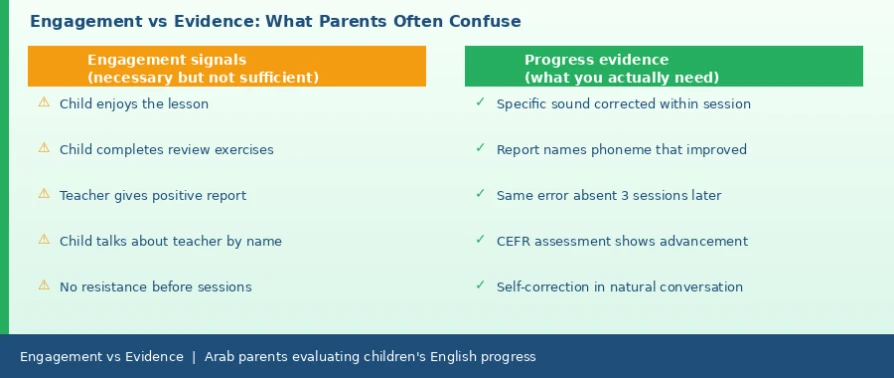
The Difference Between Engagement and Progress
Most parents evaluate online English programmes primarily through engagement signals. Their child looks forward to the sessions. She completes her homework. She talks about the teacher positively. These are good signs. They are not evidence of learning progress.
Engagement is a necessary condition for learning, but not a sufficient one. A child can be enthusiastic about sessions that are not producing measurable improvement — particularly if the sessions are enjoyable but lack the correction density that pronunciation improvement requires.
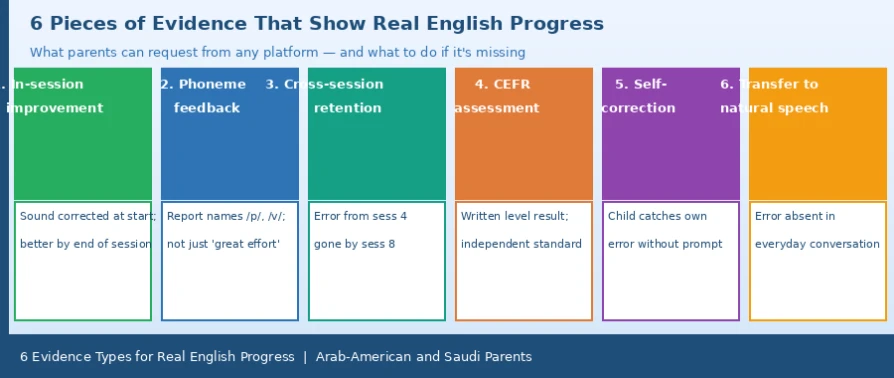
The 6 Types of Evidence to Request
Evidence type 1: In-session improvement
The teacher corrects a specific sound at the start of a session. The child produces it correctly by the end of the same session. This is the first level of evidence — improvement within a session. It is reportable: the feedback report should say ‘pen and park produced correctly by end of session after /p/ correction’.
Evidence type 2: Phoneme-specific feedback reports
The feedback report after each session names the specific phoneme that was addressed and whether it improved. A report that says ‘/p/ substitution corrected three times; child produced pen and park correctly’ is evidence. A report that says ‘great session, wonderful effort’ is not. This is evidence you can request: ask for a sample report before enrolling and check whether phonemes are named.
Evidence type 3: Cross-session retention
An error corrected in session 5 does not reappear in session 9 or 10. This is a stronger form of evidence than in-session improvement, because it shows the motor pattern has begun to change across sessions, not just within a session. How to verify: compare feedback reports across sessions. Is the same error still appearing at the same frequency, or is it reducing?
Evidence type 4: CEFR level assessment
A formal assessment against the CEFR standard produces a written level result: A1, A2, B1, and so on. This is testable evidence that is independent of the teacher’s daily reports. Ask the platform how frequently CEFR assessments are conducted and whether parents receive a written result with the level explicitly stated.
Evidence type 5: Self-correction in the lesson setting
The child produces an error, catches it herself without prompting, and corrects it before the teacher says anything. This is stronger evidence than teacher-prompted correction, because it shows the correction pattern is beginning to internalise. How to verify: note whether self-correction events appear in the feedback report and whether they are increasing in frequency.
Evidence type 6: Transfer to natural speech
The child produces the corrected sound correctly in a normal conversation outside the lesson — without prompting, without the teacher present, without consciously thinking about it. This is the strongest and slowest form of evidence. How to verify: observe your child speaking English casually at home or with friends. Are the Arabic transfer errors that were present before the programme starting to reduce?
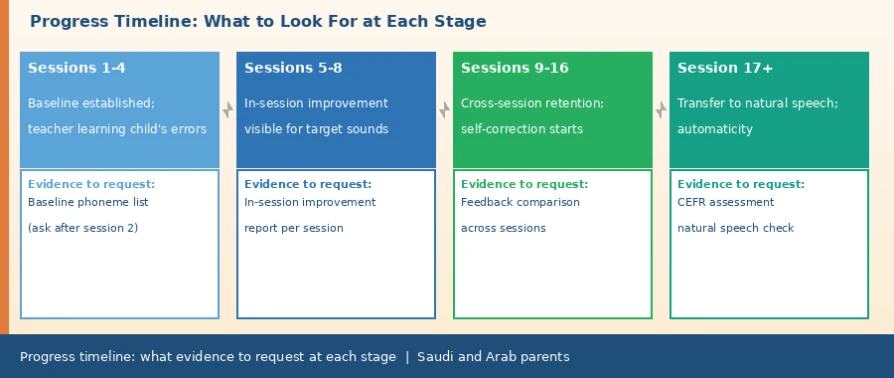
Evidence Checklist for Parents
| Evidence type | How to request it | When to expect it | What to do if absent |
| In-session improvement | Read feedback reports after each session | Sessions 3-6 for most target sounds | Ask teacher: which sound showed most improvement today? |
| Phoneme-specific reports | Request sample report before enrolling | From session 1 onwards | Ask whether more specific reporting is possible |
| Cross-session retention | Compare reports from session 4 and session 8 | Sessions 8-12 | Ask: is this error appearing at the same rate or reducing? |
| CEFR level assessment | Ask platform for written result | Every 6-8 weeks typically | Request a formal reassessment if not offered |
| Self-correction in lesson | Note whether reports mention it | Sessions 10-16 | Ask teacher to note when self-correction occurs |
| Transfer to natural speech | Observe child in casual English | Month 3+ | Increase frequency and review if absent at month 3 |
Where 51Talk’s Evidence System Fits
What 51Talk is
51Talk is a live one-on-one English platform for children. Sessions are 25 minutes, delivered by qualified teachers, structured around CEFR levels and Cambridge English learning goals. The lesson cycle includes a pre-class warm-up, the live session with real-time correction, post-class review exercises linked to that session’s sounds, a written teacher feedback report, and regular level assessments.
Evidence types 51Talk addresses structurally
-
In-session improvement: the teacher hears every production and documents improvement within session in the feedback report.
-
Phoneme-specific reports: part of the standard lesson cycle. Request a sample before enrolling to verify the level of detail.
-
Session note carry-over: the teacher at the next session has access to prior session notes, enabling cross-session retention tracking.
-
CEFR level assessments: available at regular intervals. Ask for the written result with the CEFR level explicitly stated.
What parents need to confirm directly
Request a sample feedback report before enrolling. Ask whether the teacher has experience with Arabic-speaking learners and will note Arabic-specific transfer errors in feedback. Ask how frequently CEFR assessments run and whether you receive a written result. Check current programme details and book a trial lesson at 51talk.com.
What to Do Next
Before enrolling in any programme, request a sample feedback report and check whether it names specific phonemes. After session two, read the report and note whether it names a sound that was addressed. After session eight, compare the report to session two. After month two, ask for the CEFR assessment result. At month three, listen to your child speaking English casually and note whether the errors that were present at enrolment are reducing.
If none of the six evidence types are visible after three months at the recommended session frequency, the programme needs to change: either the approach, the teacher, or the session frequency.
Frequently Asked Questions
Does 51Talk’s feedback report include phoneme-specific detail that I can use as progress evidence?
51Talk’s lesson cycle includes a written feedback report after each session. Whether that report names specific phonemes depends on the teacher assigned and the reporting standard in place. Request a sample feedback report before enrolling and check specifically whether phonemes are named. Ask the teacher after the trial: which specific sound did you work on today and what changed within the session? A teacher who answers specifically is tracking what matters. A trial lesson is available at 51talk.com.
My child’s teacher always says ‘great session’ in the report. How do I get more specific feedback?
Ask the teacher directly by email or chat: can the feedback report include the specific phoneme addressed today and whether it improved within the session? Most teachers can provide this when asked. If the platform’s reporting system does not support it, ask the platform whether more detailed phoneme feedback is possible. If the answer is no, that is a structural limitation worth factoring into your evaluation.
How do I know if the CEFR level assessment is genuine or just a platform-generated label?
A genuine CEFR assessment produces a written result that names the specific level (A1, A2, B1, and so on) and describes the evidence for that level across at least speaking, listening, and reading skills. A platform-generated badge that says ‘Level 3’ or ‘Star Learner’ is not a CEFR assessment. Ask for the CEFR level explicitly and ask what the assessment process involved. An assessment that consists solely of in-app activities without teacher evaluation is not a reliable CEFR measure.
After 3 months, my child is still producing /b/ for /p/ in normal conversation. Does that mean the programme failed?
Not necessarily. Transfer to natural speech is the slowest form of evidence — typically appearing at month three or later at three sessions per week. First check whether the other evidence types are present: is in-session improvement happening? Are feedback reports noting phoneme progress? Is cross-session retention occurring? If those are all yes, natural speech transfer is likely building and will appear soon. If none of the earlier evidence types are present, the programme is not delivering the correction needed and the approach or platform should change.