Most Saudi parents already know that their child needs to practise English pronunciation. What is less clear is what that practice should actually look like, in what order the stages should happen, and why general English exposure is not enough on its own.
Arabic and English have very different sound systems. The sounds that cause the most persistent difficulty for Saudi children, /p/, /v/, /ch/, and /sh/, do not exist in Arabic in the way English uses them. That means the brain has never built a motor pattern for producing them or an auditory map for reliably hearing them. Both gaps need to be closed deliberately, and they need to be closed in the right sequence.
This guide sets out a four-stage training path: listening, repetition, contrast drills, and live feedback. Each stage builds on the one before it. Skipping to stage four without stages one through three is like asking a child to sprint before they have learned to walk steadily. The stages are practical, the home activities are low-cost and short, and the guide is designed to work alongside a structured one-on-one English programme rather than replace it.
If your child has difficulty with sounds in Arabic as well as English, a speech-language pathologist should be involved before starting pronunciation training. The guidance here is for children whose Arabic development is broadly on track.
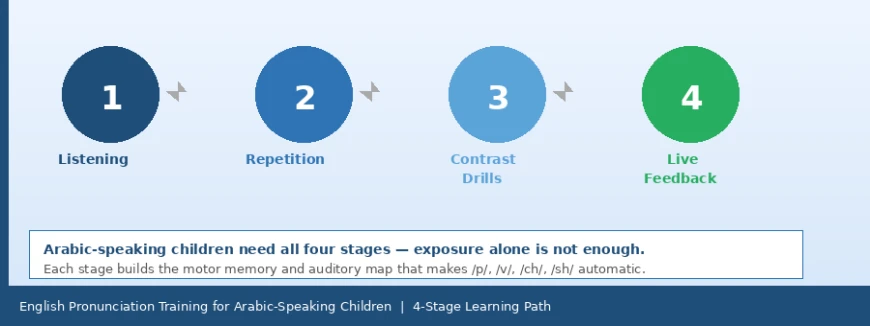
Why the Sequence Matters
Pronunciation is a motor skill. Learning to produce /p/ is not very different from learning to ride a bicycle: the brain needs to hear what the target feels like, practise the physical movement in isolation, learn to distinguish it from similar movements, and then use it automatically under real communication pressure. Each of those is a separate cognitive step, and each one depends on the previous.
Arabic-speaking children face two distinct challenges when learning English sounds that do not exist in their first language. The first is auditory: the ear has not been trained to hear the distinction between /p/ and /b/, so even when a child tries to produce /p/, they often cannot tell whether they succeeded. The second is motor: the mouth has never practised the lip-release-and-air-burst combination that /p/ requires, so the closest available pattern, /b/, fills the gap automatically.
Training the ear and training the mouth require different activities. Listening practice alone does not build motor memory. Repetition drills alone do not train the ear to catch its own errors. Contrast drills that force the brain to hear and produce both sounds back to back address both simultaneously. And live feedback from a qualified teacher embeds all of it in real communication, where the sound has to work under pressure.
Miss any stage and the others become less effective. A child who drills /p/ without ever developing an accurate auditory map of the sound cannot self-correct. A child who has only listened passively for months but never practised the mouth position will freeze when asked to produce it on demand.
Stage 1: Listening
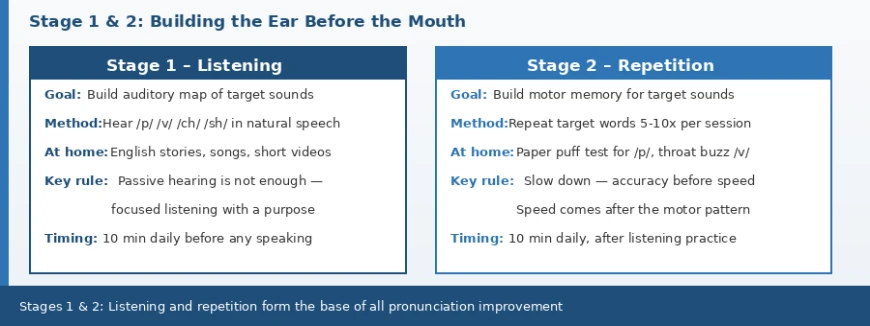
The first stage is building an accurate internal model of the target sound. Before a child can produce /p/ correctly, they need to hear it clearly enough times in enough contexts that the brain begins to treat it as a distinct sound rather than a variant of /b/. This process is called building a phonemic category, and it happens faster than most parents expect when the listening is focused rather than passive.
What focused listening means
Passive exposure to English, watching cartoons, hearing adults speak, sitting in an English class, builds vocabulary and general fluency over time. It does not reliably build accurate phonemic categories for sounds the child’s first language does not have. The difference is whether the child’s attention is directed at the specific sound.
Focused listening means giving the child a task. “Listen to this sentence and clap every time you hear a /p/ sound.” “Can you hear the difference between these two words: pen and ben?” “Which word starts with a puff of air: park or bark?” These tasks force the auditory system to discriminate the target sound from its Arabic substitute, which is exactly the gap that needs closing.
Practical activities for home
1. Sound-spotting. Read a short sentence aloud or play a short English clip. Ask the child to raise their hand every time they hear /p/ or /v/ or /ch/. Start with /p/ since it is the most frequent and easiest to isolate.
2. Word identification. Say pairs of words slowly: pen and ben, van and fan, chip and ship. Ask the child to point to the written word or picture that matches what you said. The child does not need to produce anything yet. Identification comes before production.
3. Same or different. Say two words at a time. The child says “same” or “different”. Start with very different pairs, then move to minimal pairs as the ear gets sharper.
4. Pause and predict. While reading a short English story aloud, pause before a word with a target sound and let the child fill it in. “I need a new ___” (pen). Prediction forces active listening rather than passive absorption.
Keep listening practice to ten minutes a day. Longer sessions lose focus and active listening is cognitively demanding. Consistent short sessions across the week beat one long session at the weekend.
Stage 2: Repetition
Once the ear can reliably hear the distinction, the mouth needs to learn to produce it. This is the repetition stage, and it is where most children in standard English classes get stuck, because teachers often model a sound once, get a vague approximation, and move on. Pronunciation is built through many attempts at the same sound, with physical feedback at each attempt.
Physical feedback tools
The reason pronunciation errors persist despite years of exposure is that many sounds are difficult to feel from the inside without a reference point. These tools give children external confirmation of whether they produced the sound correctly.
• The paper-puff test for /p/. Hold a thin strip of paper or a tissue a few centimetres in front of the mouth. /p/ produces a clear puff of air that moves the paper. /b/ produces almost none. This gives the child instant, accurate feedback without needing a teacher in the room.
• The throat-buzz check for /v/. Place two fingers lightly on the front of the throat. /v/ creates a vibration you can feel. /f/ does not. Ask the child to hold the /v/ sound for three seconds: /vvvv/. If they can feel the buzz, the voicing is right. If they cannot, they are producing /f/ instead.
• The tongue-tap starter for /ch/. /ch/ begins with a brief tongue contact on the roof of the mouth, like a very quick /t/, before releasing into /sh/. Ask the child to say “t-sh” slowly and then speed it up. The physical sensation of the tongue tap at the start is what distinguishes /ch/ from /sh/, and once the child can feel it they can produce it on demand.
• The lip-round check for /sh/. /sh/ requires the lips to round forward slightly. Ask the child to look in a mirror and check whether their lips are moving forward when they produce the sound. If the lips are flat, the sound will be slightly off.
Repetition structure
For each target sound, follow this sequence in a practice session. Say the sound in isolation first: /p/, /p/, /p/. Then move to a simple word: pen, pen, pen. Then to a phrase: a new pen, a new pen. Then to a full sentence: I need a new pen. This graduated structure builds the motor pattern at each level before adding the cognitive load of a full sentence.
Aim for five to ten repetitions per word per session. Speed is not the goal at this stage. Slow, accurate production with physical feedback beats fast, approximate production. Speed comes automatically once the motor pattern is established.
Words to use in repetition practice
/p/ words: pen, park, pay, cup, map, open, happy, purple, important
/v/ words: van, vine, very, love, seven, over, November, conversation
/ch/ words: chair, cheese, lunch, teacher, kitchen, chocolate, approach
/sh/ words: shop, fish, wash, shoulder, English, fashion, mushroom
Stage 3: Contrast Drills
Repetition practice in isolation builds the motor pattern, but it does not train the brain to switch between the correct sound and its Arabic substitute in real time. That is what contrast drills do. The child hears both sounds back to back, produces both, and learns to feel the difference in the moment. This is the stage where the distinction stops being an effort and starts becoming automatic.
How minimal pair drills work
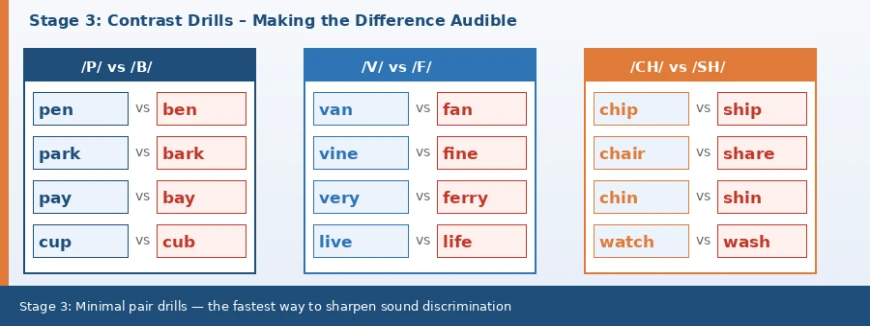
A minimal pair is two words that differ by exactly one sound. Pen and ben differ only in the first consonant. Van and fan differ only in the first consonant. Chip and ship differ only in the first consonant. Drilling minimal pairs forces the auditory system and the motor system to work together: the child must both hear the distinction and produce it in quick succession.
The drill structure is simple. The parent says one word from the pair. The child identifies which word was said (pointing to a picture or written word) and then produces the same word back. Then the parent says the other word. The child identifies and produces it. Then both words are said in quick succession. The point is not to trick the child but to make the contrast sharp and audible.
Minimal pairs for each target sound
/p/ vs /b/: pen/ben, park/bark, pay/bay, cap/cab, pin/bin, cup/cub, rip/rib, tap/tab
/v/ vs /f/: van/fan, vine/fine, very/ferry, veil/fail, vote/float, live/life, leave/leaf
/ch/ vs /sh/: chip/ship, chair/share, chin/shin, cheap/sheep, cheese/she’s, match/mash, watch/wash
/th/ vs /d/ or /t/: this/dis, that/dat, think/tink, three/tree, the/de, them/dem, then/den
Do not introduce all four pairs at once. Start with /p/ vs /b/ until the child can identify and produce the distinction reliably without effort. Then add /v/ vs /f/. Then /ch/ vs /sh/. Adding too many contrasts at once slows progress because the auditory system cannot sharpen multiple categories simultaneously.
Progression markers
Move from stage three to stage four when the child can do the following without hesitation: identify the correct word from a minimal pair nine out of ten times, produce both words in a minimal pair correctly when asked, and catch themselves if they produce the wrong sound and self-correct without prompting. These are not tests. They are observations you can make during normal practice sessions.
Stage 4: Live Feedback
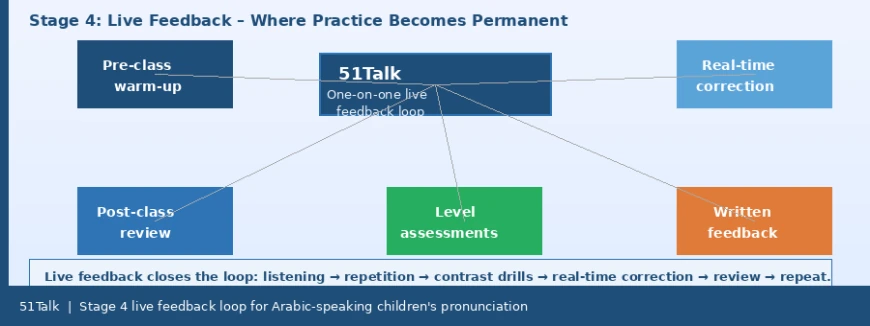
The first three stages can largely be done at home. The fourth stage requires a qualified teacher. This is where the pronunciation work that has been building in controlled conditions gets tested in real communication, and where a teacher’s real-time correction makes the difference between a pattern that sticks and one that slowly reverts.
Why home practice alone is not enough
A child who has been practising /p/ at home with the paper-puff test knows what the sound should feel like in isolation. But in a real conversation, there is no tissue in front of the mouth, no slow countdown before the word, and no moment to consciously position the lips before speaking. The brain defaults to its fastest available pattern, which for Arabic-speaking children producing /p/ is still /b/ under pressure, unless the correct pattern has been drilled in real communication conditions enough times to become the default.
A qualified teacher in a one-on-one session creates that condition. The child speaks. The teacher listens to every production. When /b/ appears where /p/ should be, the teacher addresses it immediately, in context, in the middle of a real sentence, and gets the child to repeat the word correctly before moving on. That is a fundamentally different kind of practice from isolated drills at the kitchen table, and it is what drives the final stage of automaticity.
What live feedback requires from the platform
• One-on-one format. A group class cannot provide the same correction density. Individual errors go unnoticed in a group, and the child cannot get a personalised repeat attempt at the specific sound they missed.
• Real-time correction with modelling. The teacher must address errors in the moment, name the specific sound, and demonstrate the correct mouth position before asking the child to repeat. Saying “try again” without specifying what to change is not feedback.
• Post-class review targeting session sounds. What was practised in the live session needs to be revisited in exercises between sessions. Motor memory consolidates during repetition spread across time, not just within a single lesson.
• Written feedback per session. Parents need to know which sounds were addressed so that home practice can reinforce the same targets. A written report that names /p/ substitution or /v/ voicing is actionable. A general comment is not.
How 51Talk Supports All Four Stages
For families following this four-stage path, 51Talk’s structure is built around the requirements of stage four while reinforcing stages two and three through its review system.
What 51Talk is
51Talk is a live one-on-one online English platform for children. Lessons are 25 minutes long, delivered by qualified teachers, structured around CEFR levels and Cambridge English learning goals. The lesson cycle includes a pre-class warm-up, the live session, post-class review exercises, written teacher feedback, and regular level assessments. Children work through a defined curriculum with clear level progression.
Why it fits the four-stage path
• Stage 1 support: pre-class warm-up. The warm-up before each session often includes listening activities that prime the child’s ear for the sounds they will practise in the live lesson. This is not a replacement for dedicated home listening practice, but it reinforces the same auditory targeting.
• Stage 2 and 3 support: post-class review. The review exercises after each session are built around the sounds and vocabulary from that lesson. For a child working on /p/ and /v/, this means the review includes repetition and contrast work on exactly those sounds. Parents can use this review as the ten-minute home drill session rather than designing their own.
• Stage 4 delivery: one-on-one live feedback. Every production is heard. Arabic transfer errors like /b/ for /p/ or /f/ for /v/ are caught and corrected in real time. The teacher can model the correct mouth position, ask for a repeat attempt, and note the error for the next session.
• Written feedback closes the loop. The feedback report after each session tells parents which sounds were addressed. That makes home practice focused rather than random: if the report says /ch/ and /sh/ were the target this week, the minimal pair drill at home uses chip/ship and chair/share, not a generic vocabulary list.
What to ask 51Talk
Before booking, ask whether the teacher has experience with Arabic-speaking learners and whether they are familiar with the common Arabic-English transfer patterns. Ask to see a sample feedback report to check whether it names specific phonemes. Ask whether post-class review exercises target the sounds from that specific session or follow a fixed template regardless of what the child worked on. These questions have clear answers and will tell you whether pronunciation work is genuinely embedded in the programme.
A trial lesson is available. During it, watch for the five-step correction pattern: notice, name, model, repeat, record. If the teacher applies it at least once during the 25-minute session, that tells you more about the quality of ongoing correction than any feature list. Check 51talk.com for current programme details and trial availability.
A Sample Weekly Practice Plan for Saudi Parents
This plan covers all four stages across a seven-day week. It assumes a 51Talk session or equivalent on Friday and uses the remaining days for home practice that reinforces the session content. Adjust based on which stage your child is currently in.
| Day | Focus | Activity | What to watch for |
| Monday | /p/ listening | Play 3 English words with /p/; child points when they hear it | Does the child notice /p/ vs /b/ in the words? |
| Tuesday | /p/ repetition | Paper-puff test: say pen, park, cup; watch paper flutter | Clear air burst on each word; no substitution of /b/ |
| Wednesday | /v/ listening | Play words with /v/: very, van, voice; child echoes | Is the lip-teeth contact audible? Does throat buzz? |
| Thursday | Contrast drills | Minimal pairs: pen/ben, van/fan, chip/ship — parent says, child points | Speed of recognition; any hesitation signals the pair to drill more |
| Friday | Live class or drill | 51Talk session or 15-min home drill on /ch/ vs /sh/ | Does the teacher catch errors? Does the child attempt repeats? |
| Saturday | Free review | Choose one sound from the week; child says 5 words without prompting | Unprompted production is the real test of retention |
| Sunday | Rest or passive | English cartoon, audiobook, or song; no drilling required | Relaxed exposure reinforces auditory memory without pressure |
All Four Stages at a Glance
Use this table as a quick reference when planning or reviewing your child’s progress. Each stage has a clear goal, a method, a home practice activity, and a recommended time allocation.
| Stage | Goal | Method | Home practice | Recommended time | | 1. Listening | Build accurate auditory map of target sounds | Focused listening to English with target sounds | English stories, songs, short video clips | 10 min/day before any speaking practice | | 2. Repetition | Build motor memory for correct mouth positions | Repeat target words slowly with physical feedback | Paper-puff test (/p/), throat-buzz check (/v/) | 10 min/day after listening | | 3. Contrast drills | Train the ear to hear and produce the distinction | Minimal pair drills: pen/ben, van/fan, chip/ship | Daily pair lists; parent reads one word, child identifies | 10-15 min/day when ready for step 3 | | 4. Live feedback | Embed correct production in real communication | One-on-one correction from a qualified teacher | Review exercises targeting session sounds | 2-3 sessions/week, 25 min each |
Where to Start
If your child is currently at the point of producing /b/ for every /p/ and /f/ for every /v/, start with stage one. Do not jump to drills until the ear can reliably hear the distinction. Ten minutes of focused listening daily for two weeks will make the repetition and drill stages significantly more effective.
If your child can hear the difference but still produces the wrong sound under pressure, they are at stage two or three. Add the paper-puff test for /p/ and the throat-buzz check for /v/. Introduce one minimal pair set at a time, starting with /p/ vs /b/ since it is the highest-frequency error and the most immediately fixable.
When the contrast drills are reliable and the child can self-correct, move to stage four. Find a one-on-one programme that provides real-time correction, post-class review targeting session sounds, and written feedback per lesson. If you want a structured starting point, 51Talk’s lesson cycle is worth evaluating against those criteria. Ask for a trial lesson and bring the five-step correction framework to it.
Pronunciation changes slowly at first, then quickly. The first breakthrough usually comes when a child hears their own /p/ produced correctly without thinking about it. Once that happens, the other sounds follow faster. The stages are the path there.
Frequently Asked Questions
Can 51Talk work on all four stages of pronunciation training with my Saudi child?
51Talk’s lesson cycle covers elements of all four stages. The pre-class warm-up supports the listening stage. The post-class review exercises support repetition and contrast practice. The live one-on-one session is the core of stage four: real-time feedback from a qualified teacher. The written feedback report closes the loop for home practice. Before enrolling, ask specifically whether the teacher is familiar with Arabic-English transfer patterns and whether post-class review exercises target the sounds from each specific session. A trial lesson is available to verify this directly. Check 51talk.com for current details.
How long does it take to move through all four stages?
It depends on the child’s age, how often they practise, and which sounds are being targeted. For most Saudi children working on /p/ and /v/, the listening and repetition stages take two to four weeks each with daily ten-minute practice. Contrast drills typically run alongside a live programme for four to six weeks before the distinction becomes automatic. Stage four is ongoing: live feedback should continue for as long as the child is developing English fluency. The sounds that respond fastest are /p/ (because the paper-puff test gives immediate physical feedback) and /v/ (because the throat-buzz check is equally reliable). /ch/ vs /sh/ typically takes longer because the distinction involves a two-part motor sequence.
My child has been in English class for two years and still says /b/ for /p/. Why has it not fixed itself?
Because no one has explicitly targeted it. Group English classes prioritise vocabulary, grammar, and reading comprehension. Individual phoneme errors that do not cause a comprehension breakdown, and /b/ for /p/ rarely does in context, are easy to overlook session after session. The pattern persists not because it is stubborn but because it has never been directly addressed. A qualified teacher in a one-on-one session who knows to listen for this substitution and correct it every time it appears will produce more change in eight weeks than two years of group classes that treated pronunciation as background.
Should I correct my child at home when they mispronounce a sound in normal conversation?
Not mid-sentence. Consistent mid-conversation correction makes children self-conscious and sometimes reluctant to speak, which is counterproductive. A better approach is to keep a mental note and address it in the designated practice time when correction is expected and the child is mentally prepared for it. During the five to ten minute daily practice slot, correction is part of the contract. In normal conversation, the priority is communication and confidence. The two contexts work best when they are kept separate.
Is there a difference between how /p/ should be taught to a four-year-old vs a ten-year-old?
The physical technique is the same: the paper-puff test works equally well for both. The difference is in how long the listening stage needs to run. Younger children’s phonological systems are still actively developing, which means new phonemic categories form faster with less resistance. A four-year-old who starts focused listening practice for /p/ may move to repetition within a week. A ten-year-old whose brain has spent years treating /b/ as the correct substitute may need two to three weeks of listening before the auditory distinction is sharp enough to support accurate production. That is not a limitation; it just means the stages take slightly longer at older ages.
Can I do all four stages without a paid English programme?
Stages one through three can be done almost entirely at home with the activities described in this guide. Stage four, live feedback from a qualified teacher with real-time correction, requires a teacher. An informal arrangement with a native-speaking friend or relative can provide some of this, but it lacks the structured feedback cycle, the session continuity, and the documented follow-up that make the correction stick across many sessions. A structured one-on-one programme is not strictly necessary for stages one to three, but it is the most reliable delivery mechanism for stage four.