Your child has been in English class for a while. Their reading is coming along. Their vocabulary is growing. But when they open their mouth, something still sounds off. They say “ferry” when they mean “very”, or “ship” when they are trying to say “chip”. These are not random mistakes.
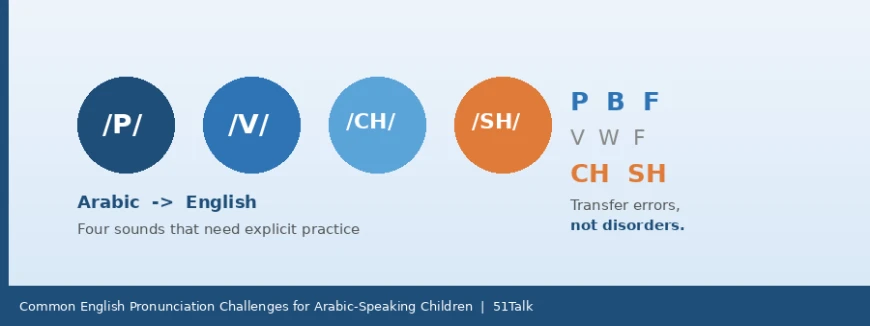
For Arabic-speaking children, four English sounds cause the most consistent difficulty: /p/, /v/, /ch/, and /sh/. None of these sounds exist in Modern Standard Arabic or most Gulf dialects in the way English uses them. That is why children do not naturally pick them up through exposure alone. They need explicit practice.
This page covers what causes each problem, how to explain it to your child at home, and what good in-class practice looks like. It is written for Saudi parents who want to understand what is happening with their child’s English pronunciation and how to support it. It does not address speech disorders. If your child has difficulty producing sounds in Arabic as well, a speech-language pathologist is the right first step.
Why These Four Sounds in Particular
Arabic has around 28 consonants, including several sounds English does not have at all, like the pharyngeal /ayn/ or the uvular /qaf/. But the relationship works both ways: English has sounds that simply do not appear in Arabic, and those are the ones that cause persistent errors.
• /p/ does not exist in Arabic. The closest Arabic sound is /b/, so children substitute it automatically.
• /v/ does not exist in Arabic. Children typically replace it with /f/ (voiceless) or occasionally /b/.
• /ch/ as in “chair” is absent from most Arabic dialects. It is often replaced with /sh/ or sometimes /j/ as in “jump”.
• /sh/ actually does exist in Arabic, but the tongue and lip position differs from English, which can make the sound slightly off and easy to confuse with /ch/.
These errors are not signs of a learning problem. They are predictable outputs of a well-functioning Arabic phonological system encountering sounds it has not been trained on. Every Saudi child learning English faces the same four hurdles. The difference between children who clear them and those who do not almost always comes down to whether the sounds were explicitly taught and practised.
The /P/ Sound
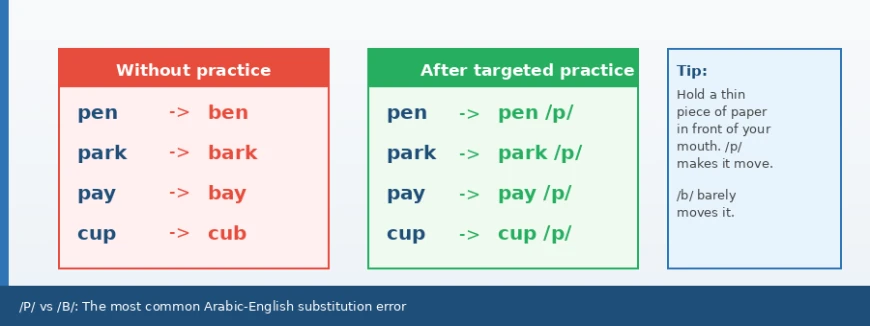
This is the most common error, and it is also the most fixable with targeted practice. Arabic has no /p/ phoneme, so the brain defaults to /b/, which is the nearest equivalent. The child is not being careless. They are doing exactly what their sound system tells them to do.
What is different about /p/
Both /p/ and /b/ are made by pressing both lips together and releasing air. The difference is that /b/ vibrates the vocal cords and /p/ does not. /p/ also produces a stronger burst of air. If you hold your hand a few centimetres in front of your mouth, you feel a clear puff of air when you say “pen” correctly. You feel almost nothing with “ben”.
How to practise at home
1. Hold a strip of paper or a tissue in front of your child’s mouth. Say /p/ words and watch whether the paper moves. “Pen”, “park”, “pay”, “cup”, “map”. The paper should flutter for each one.
2. Contrast pairs out loud: say “pen” and “ben” back to back, slowly. Ask your child to point to which word you are saying. Then swap.
3. Start with word-initial position: /p/ at the start of a word is easiest to hear and feel. “Pen”, “park”, “people”, “purple”.
4. Move to word-final position later: “cup”, “map”, “stop”, “hop”. The air burst is less strong here and harder to feel.
Words to use in practice
Easy: pen, pay, pin, park, put, up, cup, map, hop, stop
Medium: people, purple, paper, happy, open, copy
Hard: competition, perspective, important, apparently
The /V/ Sound
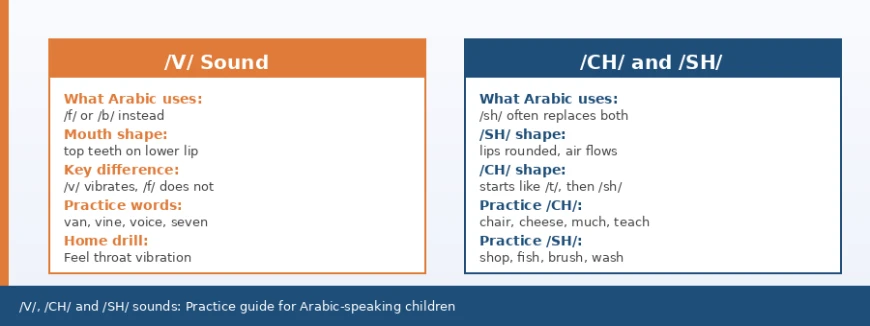
Arabic does not have /v/ as a distinct phoneme, though some dialects have borrowed it for words like “video” and “visa”. Most Saudi children replace /v/ with /f/, which is voiceless. A few replace it with /b/. Either way, the result is a consistent error that affects comprehension in words like “very”, “van”, “voice”, and “live”.
What is different about /v/
The key difference between /f/ and /v/ is voicing. To produce /v/, the upper teeth rest gently on the lower lip and air flows through while the vocal cords vibrate. For /f/, the same mouth position is used, but the vocal cords are silent. You can demonstrate this to your child by placing two fingers lightly on the throat: /v/ creates a buzz you can feel, /f/ does not.
How to practise at home
1. Demonstrate the throat buzz: say a long /vvvvv/ and a long /fffff/ and ask your child to place their fingers on your throat to feel the difference. Then they try it on themselves.
2. Contrast pairs: “fan” vs “van”, “fine” vs “vine”, “ferry” vs “very”, “fast” vs “vast”. Slow the words down so your child can feel their own throat.
3. Use a mirror: check that the top teeth are touching the lower lip, not the upper lip.
4. Say the sound in isolation first: a long /vvvv/ before moving to words. Isolating it helps children separate the motor action from the whole word.
Words to use in practice
Easy: van, vine, very, voice, give, live, love
Medium: seven, every, over, heavy, oven, river
Hard: vocabulary, November, eventually, conversation
The /CH/ and /SH/ Sounds
These two sounds are often confused with each other, and Arabic-speaking children typically collapse them into a single sound, which is usually a version of /sh/. Understanding why they are different helps a lot.
How /sh/ works
The tongue pulls back slightly and the lips round forward. Air flows out steadily in a hissing stream. The sound is continuous. Think of “shhhh” as a noise you would make to quieten someone. Saudi Arabic does have a version of /sh/, but the lip and tongue position can vary slightly from English, which sometimes makes the sound come out slightly off.
How /ch/ works
The /ch/ sound is not a continuous sound. It starts with a brief tongue-stop, like the /t/ in “tree”, and then releases into /sh/. It is two movements compressed together: t + sh = ch. That brief stop at the beginning is what makes “chair” different from “share”, and “chip” different from “ship”. Most Saudi children produce the /sh/ part fine. What they miss is the initial stop.
How to practise at home
1. Start with /sh/ to build the base: “ship”, “shop”, “fish”, “wash”. Make sure the lips are rounded and the tongue is not touching anything.
2. Introduce the /t/ starter for /ch/: say “t…sh” slowly, then speed it up: “tsh”, then “ch”. Pair it with a hand clap on the /t/ so the child can feel the two-part structure.
3. Minimal pair drills: “ship” vs “chip”, “share” vs “chair”, “wash” vs “watch”, “sheep” vs “cheap”. Say them slowly, then fast.
4. Use everyday vocabulary: “cheese”, “chicken”, “chocolate”, “lunch”, “beach” for /ch/. “Shell”, “shower”, “fashion”, “English” for /sh/.
Words to use in practice
/SH/ easy: shop, ship, fish, wash, brush, fresh
/SH/ medium: shoulder, fashion, mushroom, official
/CH/ easy: chair, cheese, chin, lunch, much, teach
/CH/ medium: chicken, chocolate, choose, teacher, match
All Four Sounds at a Glance
This table sets out the key differences between the four sounds so parents and children can refer to it quickly during home practice.
| | /P/ | /V/ | /CH/ | /SH/ | | Arabic substitute | /b/ | /f/ or /b/ | /sh/ or /j/ | /sh/ | | Mouth position | lips only | top teeth on lower lip | tongue back, lips round | lips round, no tongue touch | | Voiced? | No | Yes | No | No | | Air burst? | Strong | Steady flow | T-burst first | Steady flow | | Practice words | pen, park, cup | van, vine, seven | chair, cheese, teach | shop, fish, wash |
How 51Talk Supports Pronunciation Practice for Arabic-Speaking Children
Knowing what a sound should feel like is one thing. Getting consistent correction and repetition over dozens of sessions is another. That is where a structured one-on-one programme makes a real difference.
What 51Talk is
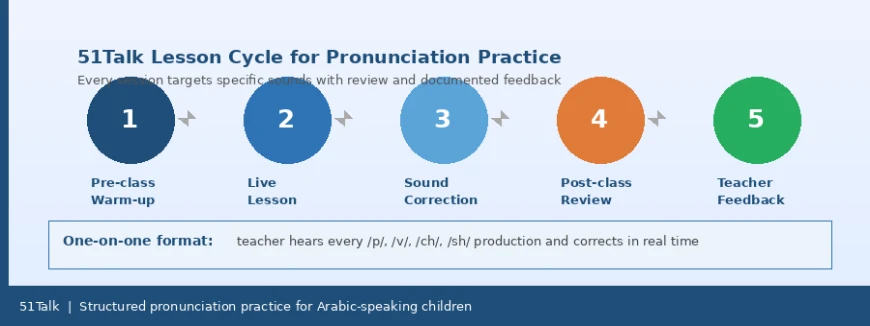
51Talk is a live online English platform that pairs children with qualified teachers for 25-minute one-on-one sessions. Lessons follow CEFR-aligned levels and Cambridge English learning goals, with a structured cycle: pre-class warm-up, live lesson, post-class review exercises, teacher feedback reports, and regular level assessments. Children progress through a defined curriculum rather than repeating disconnected topics.
Why one-on-one matters for /p/, /v/, /ch/, /sh/
• Every production is heard. In a group class, a child who says “berry” instead of “very” can go uncorrected for an entire term. In a one-on-one session, the teacher catches it immediately and addresses it in context.
• Correction is specific. A teacher who knows that /b/ is the Arabic substitute for /p/ can target the exact motor adjustment needed, not just repeat the word louder.
• Repetition is built into the lesson cycle. Post-class review exercises that come back to the same target sounds reinforce what was practised in the live session, which is how pronunciation changes over time.
• Progress can be tracked. Parents can see which sounds are improving across lessons, not just receive a general “doing well” report at the end of term.
What to ask 51Talk before you start
• Does the teacher have experience working with Arabic-speaking learners?
• Are specific phoneme errors documented and followed up across sessions?
• Is there a trial lesson available so you can hear how the teacher handles pronunciation correction?
You can check current programme details and availability at 51talk.com. Ask specifically about pronunciation tracking if that is your priority.
Parent Checklist: Supporting Pronunciation at Home
Classroom practice alone rarely fixes a pronunciation pattern. What happens between sessions matters just as much. Here is a practical checklist for Saudi parents.
• Five minutes a day beats thirty minutes once a week. Pronunciation is a motor skill. Short, daily repetition builds muscle memory faster than long occasional sessions.
• Use real words, not just drills. When your child mispronounces a sound in normal conversation, note it and return to it calmly at practice time. Correcting mid-sentence repeatedly can make children self-conscious.
• Celebrate the air burst. When your child produces a clear /p/ with a paper flutter, make a point of it. Physical feedback is very motivating for young learners.
• Watch English content with your child. Not to replace practice, but to give their ear more exposure to the target sounds in natural speech. Pausing to repeat a word they heard is a low-pressure way to practise.
• Ask the teacher what to focus on this week. If your child is working on /ch/ and /sh/ in class, you can reinforce exactly those sounds at home rather than practising at random.
• Keep a short log. Note which words your child got right this week that they struggled with last week. Progress is often faster than it looks, but easy to miss without a record.
What to Do Next
The four sounds covered here, /p/, /v/, /ch/, and /sh/, are where the majority of Saudi children’s English pronunciation errors are concentrated. They are also among the most responsive to targeted practice. The mouth movements involved are learnable at any age, and with consistent repetition they become automatic.
Start with /p/ if you are not sure where to begin. It is the highest-frequency sound of the four and produces the most immediate improvement in how clearly your child is understood. Add /v/ next, then work on /ch/ and /sh/ together since the contrast between them is the most useful thing to teach.
If your child needs more structured support than home practice can provide, a one-on-one programme like 51Talk gives them the consistent correction and tracked progress that group classes generally cannot. Ask for a trial lesson, listen to how the teacher handles pronunciation errors, and check whether feedback is documented across sessions.
The sounds will come. They just need the right practice, often enough, for long enough.
Frequently Asked Questions
Can 51Talk specifically target /p/, /v/, /ch/, and /sh/ for my Saudi child?
What 51Talk offers is qualified one-on-one instruction with post-class review and documented teacher feedback. The one-on-one format is the most important structural feature for pronunciation work: every production gets heard and corrected rather than overlooked. Whether a specific teacher has direct experience with Arabic-English transfer errors is worth asking before your first session. You can request a trial lesson at 51talk.com to hear how the teacher handles pronunciation feedback in practice.
Why does my child say “berry” instead of “very” even after years of English class?
Because /v/ was almost certainly never explicitly taught. Group English classes at school rarely spend time on individual phoneme production, and children whose first language lacks /v/ simply carry the /f/ or /b/ substitution forward. It is not stubbornness or inattention. The sound has not been targeted. Once it is, most children correct it within a few weeks of consistent practice.
Is there a difference between the /sh/ sound in Arabic and the /sh/ sound in English?
There is a small difference in articulation, yes. The Arabic /sh/ can be produced with slightly different tongue placement and less lip rounding than English /sh/. For most learners this does not cause a major comprehension problem, but it can make the sound seem slightly off. The bigger issue is that Arabic-speaking children conflate /ch/ with /sh/, producing “ship” for both “ship” and “chip”. That distinction is worth drilling specifically.
At what age should my child start working on these sounds?
The earlier the better, but there is no age at which it becomes too late. Children between four and eight acquire sounds most naturally because their phonological systems are still developing. Older children and teenagers can make strong progress too, especially with one-on-one instruction and explicit feedback. If your child is in secondary school and still producing these errors, consistent targeted practice over two to three months will make a noticeable difference.
Should I correct my child every time they mispronounce a sound?
Not mid-sentence. Constant mid-conversation correction can make children reluctant to speak, which is the opposite of what you want. A better approach is to note the error and address it in a dedicated five-minute practice slot later. During practice, correction is expected and the child is mentally prepared for it. In conversation, the priority is communication. Keep the two contexts separate.
How long does it take for these sounds to become automatic?
It depends on the sound, the child’s age, and how often they practise. /p/ typically corrects fastest with the paper trick, often within a few weeks of daily practice. /v/ takes a bit longer because the vibration feedback is less obvious to young children. The /ch/ vs /sh/ distinction usually takes the most time because it requires developing a two-part motor sequence. With five minutes of daily practice and one-on-one correction in class, most children show clear improvement within six to eight weeks.