SEO Description: A four-dimension framework for Saudi parents comparing online English platforms — covering lesson duration, interaction format, scheduling flexibility, and follow-up systems, with a 12-question parent checklist and full platform comparison table.
Comparing Children’s English Learning Platforms in Saudi Arabia:
Lesson Duration, Interaction, Schedule, and Follow-Up
Every online English platform marketed to Saudi parents makes roughly the same claims: qualified teachers, engaging content, measurable progress. The marketing is difficult to evaluate because it describes outcomes rather than mechanisms. What actually determines whether a child improves is not the headline promise but the structural details underneath it: how long each session runs and whether that length fits the child’s attention window, how the teacher and child interact and whether that interaction includes real-time correction, how flexibly sessions can be scheduled around a Saudi family’s week, and what happens after the session ends.
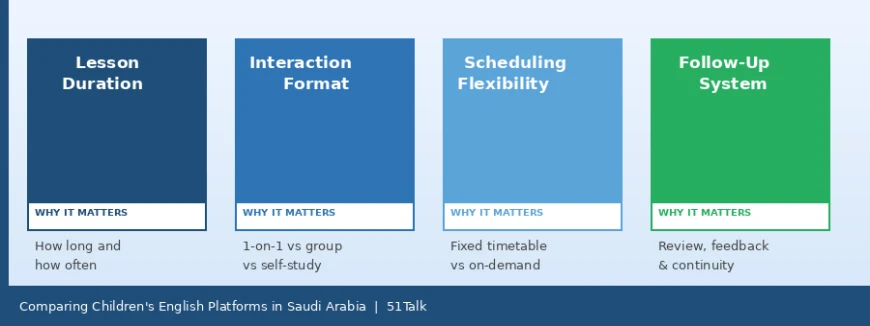
These four dimensions, lesson duration, interaction format, scheduling flexibility, and follow-up system, are not equally visible when you browse a platform’s website. Session length is usually listed. Whether the teacher documents specific phoneme errors in a written report after every lesson is rarely mentioned until you ask. This guide works through all four dimensions systematically, explains what each one means for pronunciation improvement specifically, and gives Saudi parents a framework for comparing platforms with the right questions in hand.
The comparison is not a general ranking of online English platforms. Platforms that perform less well on pronunciation correction may perform very well on other goals like conversational fluency or exam preparation. What this guide evaluates is whether each structural feature supports or undermines the specific need that comes up most often for Arabic-speaking children: fixing predictable pronunciation errors that persist because they have never been explicitly and consistently addressed.
Dimension 1: Lesson Duration
Session length is the most commonly cited feature of online English platforms and the one that tells you the least on its own. A 25-minute session can be better or worse than a 60-minute session depending on what happens inside it, how old the child is, and how often the sessions happen per week. The question is not how long the session is but whether the length fits the child’s attention window and supports the session frequency that pronunciation work requires.
Attention windows by age
Children aged five to eight maintain high-quality focused attention for roughly 15 to 20 minutes before cognitive fatigue begins to affect processing quality. Children aged nine to twelve sustain it for 20 to 30 minutes. Beyond these windows, the child may remain physically present but the retention from the session’s second half is substantially lower than from the first.
A 25-minute one-on-one session sits inside the peak attention window for most children aged five to twelve. A 60-minute lesson with an eight-year-old is not twice as effective as a 30-minute one. In practice, it delivers one strong half and one weaker half, with the correction quality in the second half degrading as attention drops.
Duration and frequency interact
The more important variable is not duration alone but duration multiplied by frequency per week. Three 25-minute sessions per week give a child 75 minutes of live instruction across three consolidation windows, meaning three separate overnight periods where motor memory solidifies. One 60-minute session per week gives 60 minutes across one consolidation window. The shorter, more frequent option produces stronger pronunciation improvement over time despite the lower total session minutes, because the forgetting curve is interrupted more often.
When evaluating any platform, the question to ask is not “how long is the session” but “how many sessions per week does this format support and how is the gap between sessions managed”.
What different session lengths suit
• 15-20 minutes: appropriate for children aged four to six. Keeps attention at peak, builds habits without fatigue. Works best for sound exposure and simple vocabulary.
• 25 minutes: the effective range for children aged seven to twelve working on pronunciation. Long enough for a full correction cycle, short enough to maintain peak attention throughout.
• 30-40 minutes: suitable for children aged ten and above with content-heavy goals like exam preparation or extended writing, where 25 minutes may not cover the material volume.
• 60 minutes: appropriate for older teenagers and adults where the content load justifies the length and attention fatigue is less severe. Rarely optimal for pronunciation correction in children under twelve.
Dimension 2: Interaction Format
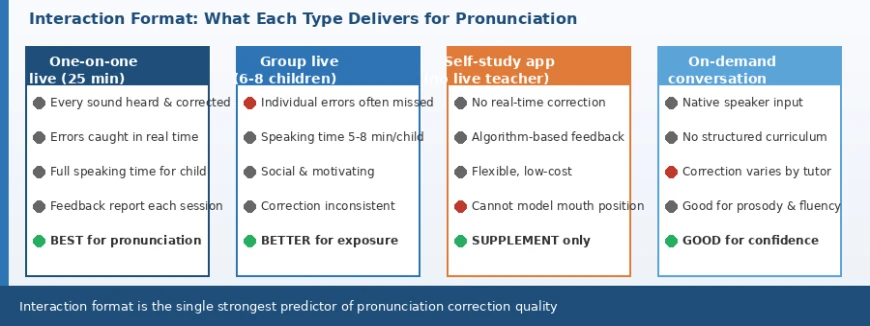
Interaction format is the strongest single predictor of whether pronunciation errors actually get corrected. The format determines who speaks, how much, and whether individual errors are heard and addressed. For Arabic-speaking children with specific transfer errors, the difference between formats is not marginal.
One-on-one live
In a one-on-one session, the teacher hears every word the child produces. There is no group noise, no queue of other children waiting, no reason for the teacher’s attention to be elsewhere. When the child says “ben” for “pen”, the teacher catches it immediately. When the child says “ferry” for “very”, the teacher stops, names the specific sound, demonstrates the correct mouth position, and asks the child to try again before moving forward.
This correction density, catching and addressing every production error in real time, is structurally impossible in a group format regardless of how skilled the teacher is. The one-on-one format is not just better for pronunciation: it is the only format that reliably delivers consistent correction of individual phoneme errors session after session.
The child’s speaking time in a well-run 25-minute one-on-one session is eight to twelve minutes. That number sounds small, but it is eight to twelve minutes of speaking time with every error corrected. That is more productive for pronunciation improvement than forty-five minutes of group class where the child speaks for five minutes and two of those minutes contain uncorrected transfer errors.
Group live
Group sessions, typically six to ten children, have genuine advantages for motivation, social dynamics, and the feeling of being in a shared learning environment. Many children who are reluctant in one-on-one settings engage more freely in a group because the stakes of any individual error feel lower.
The limitation for pronunciation is structural. Each child in a group of eight gets five to eight minutes of speaking time in a 60-minute session on average. More importantly, a teacher managing eight children simultaneously cannot stop the lesson every time one child produces a /b/ for /p/ substitution. The lesson must keep moving. Errors that would be caught and addressed in thirty seconds in a one-on-one session pass silently in group instruction.
For Arabic-speaking children whose pronunciation errors do not cause comprehension breakdown, group instruction is particularly ineffective at correcting them. The errors are not disruptive enough to flag, so they accumulate uncorrected across years of group English exposure.
On-demand conversation with native speakers
Platforms that connect children with native English-speaking tutors for unstructured conversation practice offer something genuinely valuable that structured curriculum platforms do not: authentic native-speaker prosody, connected speech, and natural intonation patterns. These features of spoken English are difficult to teach explicitly and are best acquired through listening and responding in real conversations.
The limitation is that there is no standard curriculum, no built-in correction protocol, and no mechanism for tracking which specific sounds a child is producing incorrectly across sessions. One tutor might drill /p/ carefully after hearing a substitution. The next might keep the conversation moving and never address it. For systematic pronunciation correction, that inconsistency is a structural problem, not a teacher quality problem.
Self-study apps
Self-study apps offer unlimited flexibility, low cost, and algorithm-based feedback on pronunciation. The algorithm can identify that a sound was produced incorrectly. It cannot demonstrate the correct mouth position, ask the child to watch its lips, or feel the child’s uncertainty about whether the new production was correct. For Arabic-speaking children whose errors require explicit motor instruction, apps are a useful supplement but not a primary correction mechanism.
Dimension 3: Scheduling Flexibility
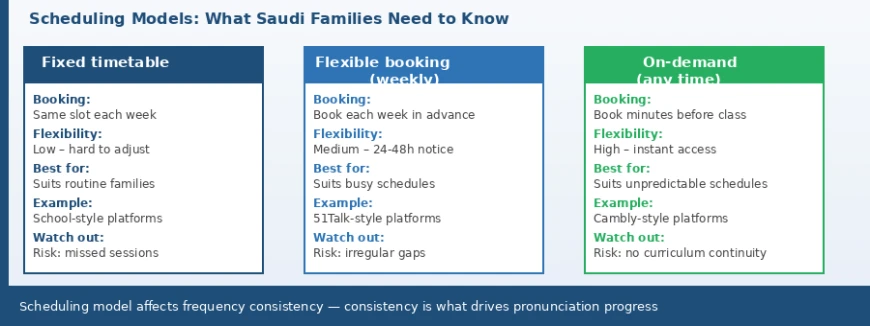
Saudi family schedules are genuinely demanding. School hours, prayer times, family commitments, Ramadan schedules, national holidays, and the travel patterns common in Gulf families all create scheduling variability that fixed-timetable platforms handle poorly. Scheduling flexibility is not just a convenience feature. For pronunciation work specifically, it is a delivery mechanism: if the schedule breaks down for two weeks in a row, the consolidation cycle that makes short frequent sessions effective is disrupted.
Fixed timetable
Platforms with fixed weekly slots work well for families with predictable routines. The lesson always happens at the same time, the child knows what to expect, and the teacher can plan across sessions because the gap between them is consistent. The risk is that a family event on a fixed session day creates a missed lesson that is difficult to recover from quickly, and that missed lessons in a high-frequency plan break the consolidation cycle at exactly the moment it needs to be sustained.
Flexible advance booking
Platforms where sessions are booked in advance each week, typically with 24 to 48 hours notice required, offer a middle ground. The family controls the weekly schedule but commits to each session in advance, which creates enough structure to maintain frequency without locking into a single immovable time slot. This model suits most Saudi families better than a fixed timetable because it accommodates both regular weeks and disrupted ones.
The risk is that flexibility makes it easy to defer. A family that can book any time this week can also find reasons to book nothing this week. The session frequency that makes the plan work requires active scheduling, not passive availability.
On-demand booking
Fully on-demand platforms, where sessions can be booked minutes before they start, offer maximum flexibility but minimum structure. For families where this is genuinely the only way to maintain any English practice at all, it is better than nothing. For families who could manage advance booking but use on-demand as an excuse not to commit to a weekly plan, it undermines the frequency model. On-demand works well for supplementary conversation practice but rarely as the primary vehicle for systematic pronunciation work.
What to ask about scheduling
• What is the minimum notice required to book a session?
• What is the rescheduling policy for missed sessions?
• Can sessions be booked at the same time each week for consistency, or is the booking always open?
• During Ramadan and Saudi national holidays, is the teacher pool available or reduced?
Dimension 4: Follow-Up System
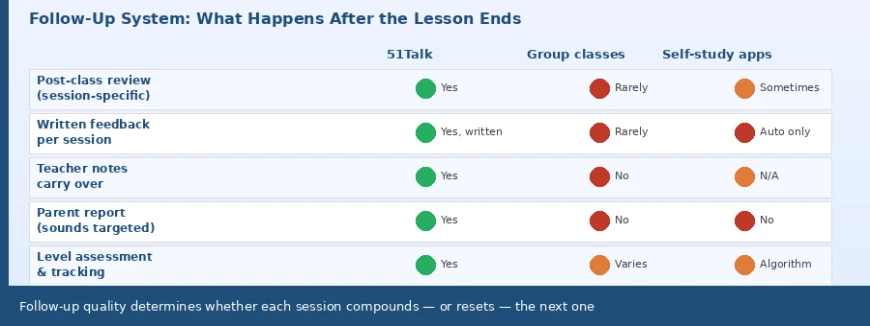
The follow-up system is the dimension least visible in platform marketing and the one that most directly determines whether the session was worth attending. A 25-minute lesson without post-class review produces roughly 25 minutes of benefit. The same 25-minute lesson followed by ten minutes of targeted review the same evening produces 35 to 40 minutes of effective learning, because the review interrupts the forgetting curve before the first overnight consolidation period.
Post-class review
Post-class review exercises that are linked to the specific sounds and vocabulary covered in that session, not a generic template, are the mechanism that converts short sessions into durable learning. When a child works on /p/ and /v/ in Monday’s session and then spends ten minutes on /p/ and /v/ review exercises Monday evening, the motor memory formed in the session is reinforced before it begins to decay. When a child does no review until Wednesday’s warm-up, two days of decay have run and the Wednesday session spends time re-establishing rather than building.
The distinction between session-specific review and generic review matters. A review that shows the child vocabulary from the curriculum level is helpful. A review that specifically returns to the /b/ for /p/ substitution that was corrected three times in today’s session is what closes the correction loop. Ask explicitly whether the review changes with each session or follows a fixed template regardless of what happened in the live lesson.
Written feedback reports
A written feedback report after each session serves two functions. First, it tells parents which specific sounds were addressed, which makes home practice between sessions directed rather than random. If the report says the teacher worked on /ch/ substitution today, the parent can run three chair/share contrasts at the dinner table that evening without needing to guess. Second, it holds the teacher accountable for having addressed pronunciation specifically. A teacher who knows a written report will name which phonemes were corrected in today’s session is more likely to address them than one who will give a general verbal summary at the end of class.
Not all feedback reports are equally useful. A report that says “great session, good effort” tells you nothing. A report that says “/p/ substitution corrected three times, child successfully produced pen and park by end of session” is actionable. When evaluating a platform, ask to see a sample feedback report and check the level of phoneme-specific detail.
Teacher continuity and carry-over
Whether the teacher at Wednesday’s session has access to Monday’s feedback before Wednesday’s session begins determines whether the corrections from Monday are reinforced on Wednesday or started from scratch. Platforms where each session is self-contained and the teacher receives no prior session notes treat the child as a new student at every lesson. That is not a teacher quality problem. It is a platform design problem.
Continuity also applies to the teacher themselves. A child who works with the same teacher across all sessions builds a relationship in which the teacher knows which specific errors to listen for, which corrections have already been attempted, and which ones are progressing. Switching teachers frequently, whether through platform policy or unpredictable availability, resets that accumulated context.
All Four Dimensions: Platform Type Comparison
This table sets out how the four common platform types compare across all four dimensions. Use it alongside the checklist below to evaluate specific platforms you are considering.
| | One-on-one live (e.g. 51Talk) | Group live (6-10 children) | On-demand conversation | Self-study app | | Session length | 25-30 min | 45-60 min | Flexible | Flexible | | Speaking time per child | 8-12 min | 5-8 min | Most of session | User-controlled | | Arabic transfer errors caught | All, in real time | Many missed | Depends on tutor | No live correction | | Pronunciation correction method | Named, modelled, repeated | Occasional, inconsistent | Varies by tutor | Algorithm only | | Post-class review (session-specific) | Yes | Rarely | No | Sometimes | | Written feedback per session | Yes (51Talk) | Rarely | No | Auto report only | | Teacher notes carry over | Yes | Sometimes | No | N/A | | CEFR-aligned curriculum | Yes | Varies | No | Varies | | Scheduling flexibility | High (book in advance) | Low (fixed timetable) | Very high (on-demand) | Unlimited | | Session frequency possible | 3-5x/week easily | 1-2x/week typical | As needed | Unlimited | | Best suited for | Pronunciation accuracy for Arabic-speaking children | General exposure social English | Fluency & confidence after foundation built | Vocabulary supplement not primary pronunciation |
How 51Talk Is Structured Across All Four Dimensions
Comparing platforms in the abstract is only useful up to a point. At some stage the question becomes: what does a specific platform actually do on each dimension? 51Talk is the platform most relevant to Saudi parents looking for structured pronunciation work, so it is worth going through each dimension specifically.
What 51Talk is
51Talk is a live one-on-one English platform for children. Sessions are 25 minutes, delivered by qualified teachers, structured around CEFR levels and Cambridge English learning goals. The lesson cycle includes a pre-class warm-up that activates content from the previous session, the live lesson with real-time correction, post-class review exercises targeted to that session’s content, a written teacher feedback report, and regular unit and level assessments.
Duration
Sessions are 25 minutes. For children aged five to twelve, this is inside the peak attention window and supports the three-to-four-session-per-week frequency that pronunciation work requires. The 25-minute length is not a cost decision; it is a pedagogical one based on attention research and motor memory consolidation principles. The format is designed for multiple sessions per week, not for a single long weekly event.
Interaction
One-on-one throughout. Every production is heard by the teacher. Arabic transfer errors like /b/ for /p/, /f/ for /v/, and /sh/ for /ch/ are caught in real time, named specifically, demonstrated with mouth position guidance, and followed by a repeat attempt from the child before the session moves forward. This is the full five-step correction cycle that group formats structurally cannot deliver at the same density.
Scheduling
Sessions can be booked flexibly, which suits Saudi family schedules better than a fixed weekly timetable. The platform is designed for multiple sessions per week. When enquiring, ask about the advance notice required for booking, the rescheduling policy for missed sessions, and whether availability is consistent during Ramadan and Saudi public holidays. These are questions with clear answers that affect the frequency model significantly.
Follow-up
Post-class review exercises are included as part of the lesson cycle and are designed around the content of each specific session rather than a fixed template. Written teacher feedback is provided after each session. Session notes carry over to the next lesson, which means the teacher at Wednesday’s session knows what was addressed on Monday. Parents can check current practice on all of these features at 51talk.com. Ask specifically to see a sample feedback report before booking to verify the level of phoneme-specific detail.
Parent Checklist: 12 Questions Across All Four Dimensions
Use this checklist when comparing any online English platform. It is organised by dimension so you can see quickly where a platform is strong and where it is worth pressing for more detail.
| Dimension | Question to ask | Field | Why it matters |
| Duration | How many minutes does the child actually speak per session? | Speaking time | Under 8 min in a 25-min one-on-one is too low; ask directly |
| Duration | How often can sessions be scheduled per week at this length? | Frequency | Duration only matters if the frequency supports motor memory consolidation |
| Interaction | Is the format one-on-one or group? | Format | Group format cannot catch individual Arabic transfer errors reliably |
| Interaction | Does the teacher demonstrate correct mouth position when correcting? | Correction method | Saying “try again” is not the same as modelling the sound |
| Interaction | Does the child attempt the corrected sound again in the same session? | Correction depth | One correction without a repeat attempt has low retention value |
| Schedule | Can sessions be booked flexibly without a fixed weekly slot? | Scheduling | Saudi family schedules require flexibility without losing frequency |
| Schedule | What is the make-up or rescheduling policy for missed sessions? | Policy | Missed sessions without rescheduling break the consolidation cycle |
| Follow-up | Is there a post-class review after every session? | Review | Without same-day review, the forgetting curve runs unchecked overnight |
| Follow-up | Does the review target the specific sounds from that session? | Review quality | Generic review is less effective than session-linked sound targeting |
| Follow-up | Is a written feedback report provided after each session? | Reporting | Written reports guide home practice; verbal summaries get forgotten |
| Follow-up | Do session notes carry over to the next lesson? | Continuity | Without carry-over, each session starts fresh rather than building |
| Follow-up | Can I request a teacher with Arabic-learner experience? | Teacher matching | A teacher who knows /b/ for /p/ is an Arabic default corrects it faster |
What to Do Next
When the four dimensions are clear, comparing platforms becomes a structured exercise rather than a search through marketing materials. Lesson duration is meaningful only in the context of frequency. Interaction format determines correction density more than any other variable. Scheduling flexibility determines whether the frequency plan survives contact with real Saudi family schedules. And the follow-up system determines whether each session compounds the previous one or starts from scratch.
For Saudi parents whose primary goal is pronunciation correction for Arabic-speaking children, the evaluation reduces to four specific questions. Is the format one-on-one? Does the teacher catch and address Arabic transfer errors specifically? Can sessions be scheduled three or more times per week without significant friction? And does a written, phoneme-specific feedback report follow every session?
If all four answers are yes, the structural conditions for pronunciation improvement are in place. Whether they are delivered depends on the specific teacher, which is why the trial lesson matters: it is the only moment where you can watch the correction quality directly rather than inferring it from platform descriptions.
Take the checklist to the trial. Note which questions the teacher’s behaviour answers without you needing to ask. Ask the rest directly afterwards. Save the feedback report. And if the answers are clear and specific, you have found a programme whose structure is built to deliver what Arabic-speaking children’s pronunciation work actually requires.
Frequently Asked Questions
How does 51Talk’s follow-up system work specifically, and is it the same for every session?
51Talk’s lesson cycle is described as including a pre-class warm-up, the live session, post-class review exercises, and a written teacher feedback report per session. The platform is designed for these elements to be consistent across every lesson rather than occasional. Before booking, ask to see a sample feedback report to verify the level of phoneme-specific detail, and ask whether the review exercises are session-specific or follow a fixed template regardless of what happened in the live lesson. Both questions have clear answers and will tell you whether the follow-up system genuinely closes the correction loop or functions as a formality. Check current details at 51talk.com.
My child’s current platform has a 60-minute group class once a week. Is that worth keeping alongside a one-on-one programme?
Yes, as a supplement. The group class provides social English exposure, peer interaction, and vocabulary input that one-on-one sessions are not optimised to deliver. The problem is treating it as the primary vehicle for pronunciation correction, which it is not. A child who attends a 60-minute group class once a week and also has three 25-minute one-on-one sessions per week with real-time pronunciation correction will progress faster on pronunciation than a child doing only the group class. The combination works; the question is whether the one-on-one sessions are available and whether the family schedule can sustain both.
Is scheduling flexibility actually important, or is a fixed timetable fine?
It depends on the family. If your schedule is genuinely consistent and the same time slot is reliably available every week, a fixed timetable is fine and may even be preferable because it removes the decision-making from each week. The problem with fixed timetables arises when Saudi family life, which involves national holidays, Ramadan schedule changes, travel, and family events, repeatedly conflicts with the fixed slot and produces missed sessions that cannot be made up quickly. For families with variable schedules, a platform that allows flexible advance booking protects the session frequency that pronunciation work requires.
How do I check if a teacher has experience with Arabic-speaking learners before the trial lesson?
Ask the platform directly when you enquire about booking. Specifically ask whether you can request a teacher who has worked with Saudi or Gulf Arabic-speaking children and who is familiar with common Arabic-English phonological transfer patterns. The patterns worth mentioning are /b/ for /p/, /f/ for /v/, /sh/ for /ch/, and /d/ or /t/ for /th/. A platform that can give you a concrete answer to this question has a teacher-matching system that considers learner background. A platform that gives a vague general answer should prompt you to ask again during the trial booking.
What should the written feedback report actually contain for it to be useful?
At minimum, a useful feedback report for pronunciation work should name the specific sounds that were addressed in the session, note whether the child showed improvement within the session, and indicate which sounds need continued attention at the next session. Statements like “/p/ substitution corrected three times; child successfully produced pen and park independently by end of session” or “/v/ voicing still defaulting to /f/ under speed; revisit with throat-buzz check” are actionable. Statements like “great session today, worked hard” are not. When you receive the first feedback report after a trial lesson, read it specifically for phoneme-level detail. If it does not contain any, ask the teacher or platform whether more specific reporting is possible.
Can a self-study app replace any part of the four-dimension framework?
Apps can supplement the review component of the follow-up system and add vocabulary exposure between sessions. They do not replace any of the other three dimensions. An app cannot deliver one-on-one real-time correction because there is no live teacher. It cannot make scheduling decisions for a family. And its feedback is algorithmic: it can identify that a sound was produced incorrectly but cannot demonstrate the correct mouth position, model the lip-release for /p/, or tell the child to feel the throat vibration for /v/. Use apps for vocabulary practice and review reinforcement between live sessions. Do not rely on them as the primary mechanism for pronunciation correction.