Arab-American families searching for online English programmes face a specific problem that most platform comparison guides do not address. Their children are not beginners. They speak English every day. They are in American schools. And yet something is off in their pronunciation — the /b/ for /p/ swap, the /f/ for /v/ pattern, or the way /th/ sounds like /d/ or /t/. These are Arabic phonological transfer errors, and they do not disappear through more English exposure. They need individual correction from a teacher who knows what to listen for.
This article compares four structural features of online English platforms that determine whether any programme actually addresses that specific need: the lesson format (private or group), the teacher’s knowledge of Arabic-English phonology, the quality of the trial class experience, and what the follow-up system looks like after each session. It does not rank platforms by overall quality. It gives Arab-American parents a framework to compare any platform they are evaluating.
It does not cover speech disorders or clinical language delays. If your child shows difficulties in Arabic as well as English, a speech-language pathologist should be consulted before starting an online programme.
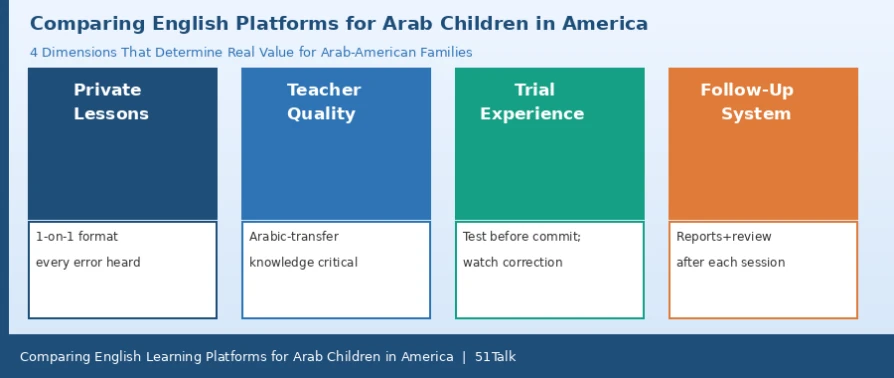
Why These Four Dimensions Matter More Than Marketing Claims
Every platform in the online English tutoring market uses similar language: qualified teachers, proven results, engaging curriculum. None of that language tells you whether the teacher has ever worked with an Arabic-speaking child or whether she would catch a /b/-for-/p/ substitution if she heard one.
The four dimensions below are structural. They describe what the programme is designed to do, not what it claims. A platform can promise pronunciation improvement in its marketing and still be running 60-minute group classes where each child speaks for six minutes and no individual phoneme error is ever directly addressed. The structural dimensions cut through that.
Dimension 1: Private Lessons vs Group Classes
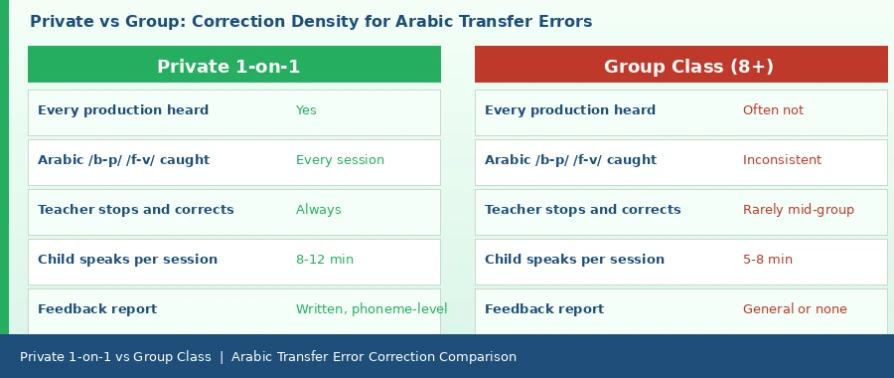
This is the most consequential structural difference. In a private one-on-one lesson, the teacher hears every word the child produces. There is no group dynamic, no other children waiting, no reason for the teacher’s attention to be elsewhere. When the child says “ferry” instead of “very”, the teacher hears it, stops, names the specific sound, demonstrates the correct position, and gets a repeat attempt before the session moves forward.
In a group class, that same error passes silently. The teacher is managing eight children simultaneously. The error does not block communication. The lesson keeps moving. And the pattern consolidates for another week.
Arab-American children who have already been through years of school English instruction — and still produce Arabic transfer errors — are demonstrating that group-format correction is not enough for them specifically. The individual format is not just better. For this particular need, it is the only format that reliably works.
Dimension 2: Teacher Knowledge of Arabic-English Phonology
A teacher who has only worked with European or East Asian learners has not encountered the specific transfer patterns that Arabic-heritage children produce. The /p/ phoneme does not exist in Arabic. The closest Arabic sound is /b/, so the substitution is automatic and deeply habitual. A teacher who has not worked with Arabic-speaking learners may not even register /b/-for-/p/ as an error — it does not block comprehension and it sounds like an accent feature rather than a correctable phoneme substitution.
The most common Arabic-English transfer errors worth asking about directly:
-
/b/ for /p/: pen becomes ben, park becomes bark
-
/f/ for /v/: very becomes ferry, voice becomes foice
-
/d/ or /t/ for /th/: this becomes dis, think becomes tink
-
/sh/ for /ch/: chair becomes share, cheese becomes sheese
Ask any platform directly: does the teacher know these patterns? Has she worked with Saudi or Gulf Arabic-speaking children before? A teacher who answers yes with specific examples is prepared. A teacher who gives a vague general answer about diverse learners is not.
Dimension 3: The Trial Class Experience
The trial lesson is the most reliable evaluation tool available to parents. No amount of platform marketing tells you more about correction quality than watching one session directly. Arab-American parents evaluating a trial should observe five specific things.
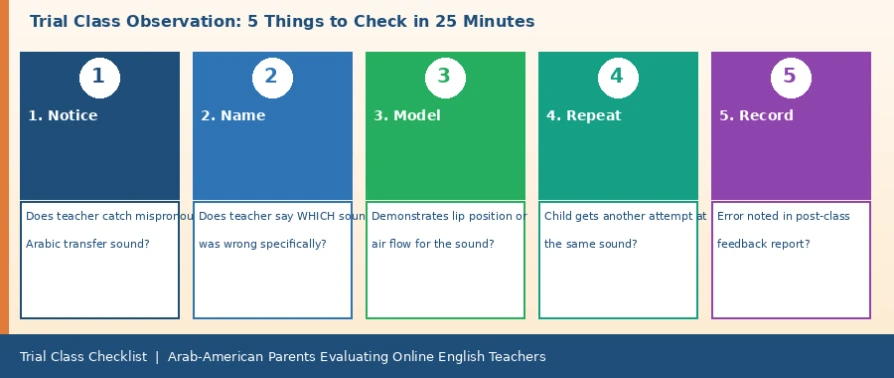
A teacher who completes the full five-step correction cycle during a trial session will do the same in every paid session. A teacher who says “try again” without naming the sound or demonstrating the position is providing incomplete correction. This is not a reflection of general teaching quality. It is a structural gap that matters specifically for phoneme-level work.
After the trial, read the feedback report. If it names a specific sound that was addressed and describes whether it improved within the session, that report is actionable. If it says “great effort today” without any phoneme detail, the feedback system is not serving pronunciation goals.
Dimension 4: The Follow-Up System
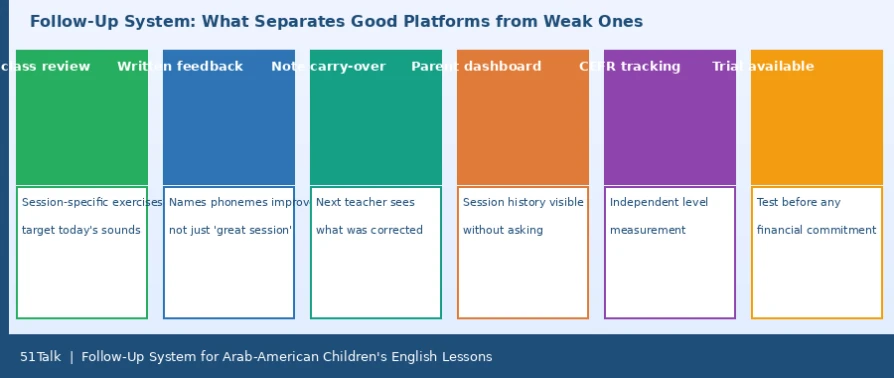
The follow-up system determines whether the session’s corrections persist into the next lesson or fade before the child gets back to the screen. Pronunciation is a motor skill. Motor memory consolidates through distributed repetition — short practice spread across days, not long sessions once a week. What happens between sessions is almost as important as what happens in them.
A strong follow-up system includes post-class review exercises that target the specific sounds from that session, a written feedback report that names phonemes and describes progress, session note carry-over so the next teacher knows what was addressed last time, and a parent-accessible dashboard that does not require chasing the teacher for updates.
A weak follow-up system is a verbal “she did really well” at the end of class and nothing else. That is not a follow-up system. That is the absence of one.
Platform Comparison Across All Four Dimensions
Use this table when comparing any online English platform for an Arab-American child. Verify each field directly rather than inferring it from marketing copy.
| Dimension | One-on-one live (e.g. 51Talk) | Group class | On-demand tutoring | Self-study app |
| Lesson format | Private, 1-on-1 throughout | 6-10 children per class | 1-on-1 but no curriculum | Self-directed, no teacher |
| Arabic transfer errors caught | Every session, real time | Frequently missed | Depends on tutor | No live correction |
| Trial class available | Yes — use 5-step checklist | Sometimes | Pay per session | Free tier usual |
| Written phoneme feedback | Yes (verify before enrolling) | Rarely | No standard | Auto only |
| Post-class review targeted | Session-specific exercises | Generic or none | None standard | App decides |
| CEFR level tracking | Yes | Varies | No | Varies |
Parent Verification Checklist
Before committing to any platform, get specific answers to these questions. Save them in writing.
| Field | Question | Why it matters |
| Session format | Is the session one-on-one or group? How many children? | Format is the single biggest predictor of correction density |
| Arabic phonology | Has the teacher worked with Saudi or Gulf Arabic-speaking children? | Teacher who doesn’t know these patterns can’t catch the errors |
| Trial lesson | Is a trial available? Can I observe and receive a feedback report after? | Trial is the only direct view of correction quality |
| Feedback quality | Can I see a sample feedback report? Does it name specific phonemes? | General reports cannot guide home practice |
| Note carry-over | Does the teacher at the next session see feedback from the previous one? | Without carry-over, corrections reset each session |
| Post-class review | Are review exercises included and linked to the specific session’s content? | Generic review is less effective than session-targeted practice |
| Teacher-change policy | What is the process and timeline for requesting a different teacher? | Know this before you need it, not after |
| Data and privacy | Where are sessions recorded? Can parents access recordings? | Verify before the first session, not after a concern arises |
Where 51Talk Fits in This Comparison
What 51Talk is
51Talk is a live one-on-one English platform for children. Sessions are 25 minutes, delivered by qualified teachers, and structured around CEFR levels and Cambridge English learning goals. The lesson cycle runs as: pre-class warm-up that activates content from the previous session, live lesson with real-time correction, post-class review exercises that target that session’s specific sounds, a written teacher feedback report, and regular level assessments.
Why 51Talk suits Arab-American children specifically
-
One-on-one format: every Arabic transfer error is heard because there is no group to absorb it silently.
-
Post-class review is session-specific: a child who worked on /p/ and /v/ today gets review exercises on /p/ and /v/ that evening, not a generic vocabulary list.
-
Written phoneme-level feedback: parents receive a report that can name sounds rather than just describe the session’s mood.
-
Session note carry-over: the teacher at Wednesday’s session knows what was corrected on Monday.
-
25-minute sessions fit busy US family schedules: three sessions per week at this length is achievable for most families and meets the frequency needed for motor memory consolidation.
What to confirm with 51Talk before booking
Ask whether you can request a teacher with specific experience working with Arabic-speaking children. Ask for a sample feedback report before enrolling. Ask whether the post-class review exercises change with each session or follow a fixed template. Check current plan details and request a trial lesson at 51talk.com. Save the answers in writing before your first paid session.
What to Do Next
Before choosing any platform, run through the verification checklist above and require specific written answers. Book the trial lesson and apply the five-step correction observation checklist during the session. Read the feedback report with attention to phoneme-level detail rather than general positivity. If the report names a specific sound and describes whether it improved, the reporting system works. If it does not, ask whether more specific reporting is possible before committing.
For Arab-American children whose Arabic transfer errors have persisted through years of US school English, the format and follow-up system matter more than any other feature. Start there. The platform’s curriculum structure and pricing are secondary decisions once you know that the correction mechanism is actually in place.
Frequently Asked Questions
Does 51Talk specifically address Arabic-to-English phonological transfer errors for Arab-American children in the US?
51Talk’s one-on-one format means the teacher hears every production the child makes, which is the structural requirement for catching Arabic transfer errors consistently. Whether a specific teacher is familiar with /b/-for-/p/ and /f/-for-/v/ patterns is worth confirming directly before booking — ask when you enquire. The platform is designed for structured CEFR-aligned correction, and a teacher who knows Arabic phonology will apply that structure directly to the transfer patterns your child produces. Request a trial lesson and ask the teacher directly about her experience with Arabic-speaking learners. Check details at 51talk.com.
My Arab-American child speaks fluent English already. Why do they need pronunciation correction lessons?
Fluency and phoneme accuracy are different things. A child can speak English every day and still produce /b/ for /p/ consistently because Arabic has no /p/ phoneme and the substitution became habitual early. These errors do not prevent communication — which is exactly why they never get addressed in school. They affect how the child’s speech is perceived in academic and professional contexts as they get older. Correcting them at age eight takes a few weeks of targeted work. Correcting them at age twenty is significantly harder.
How do I know if the trial lesson is actually testing what I need to test?
Apply the five-step correction checklist during the trial. You are looking for: does the teacher notice the error, name the specific sound, demonstrate the correct position, get the child to attempt it again, and note it for follow-up? You can test this yourself by choosing a word or phrase your child typically mispronounces and including it naturally in the session. If the teacher catches and corrects it using all five steps, that teacher will do the same in paid sessions.
What if the platform offers a good group class but no private option?
For general English exposure, fluency practice, and vocabulary building, a group class can work well alongside private pronunciation sessions. The structural problem is using a group class as the sole mechanism for addressing individual Arabic phoneme errors. If the platform only offers group format, it can serve as supplementary exposure while a separate one-on-one programme handles the phoneme correction work. Do not expect one to do the other’s job.
How many sessions per week are needed to see improvement in Arabic transfer errors?
Three sessions per week is the minimum effective frequency for Arabic transfer error work at the motor memory level. One session per week leaves a six-day gap in which the correction decays before the next reinforcement opportunity. Three sessions with post-class review the same day as each session gives three consolidation windows per week. Most Arab-American children aged seven to twelve show in-session improvement on a target sound within four to six sessions at that frequency.