Choosing an online English teacher for a hesitant child is a different task from choosing one for a confident child. The qualities that matter for a confident learner — speed, range, challenge — can be harmful for a child who is already afraid of making mistakes. The wrong teacher, even a technically skilled one, can set back a hesitant child’s willingness to speak English for months.
This article gives Saudi and Arab parents a set of practical questions to ask before booking any teacher for a child who is reluctant, quiet, or anxious about speaking English. It covers what to look for in teacher background, how to evaluate correction style in the trial, and what the feedback report should contain. It does not address clinical anxiety or selective mutism, which require a specialist.
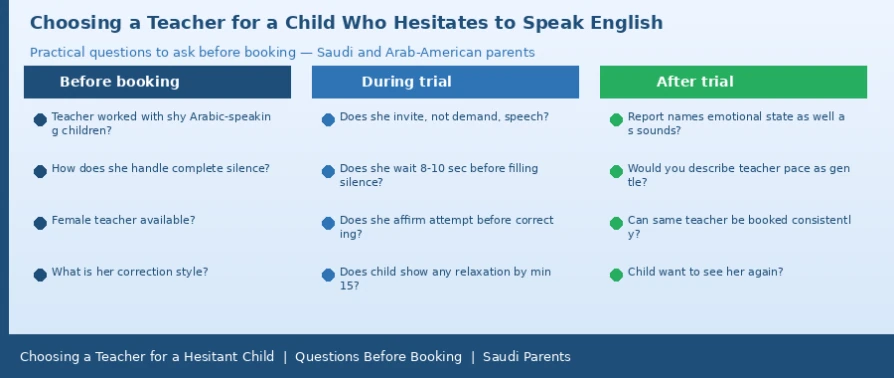
Why the Teacher Matters More Than the Platform for Hesitant Children
For most children, a technically good teacher on a well-structured platform produces good results. For a hesitant child, the teacher’s interpersonal approach matters more than any structural feature. A platform can offer one-on-one format, phoneme feedback, and CEFR tracking, and still be the wrong fit if the teacher’s correction style increases anxiety rather than reducing it.
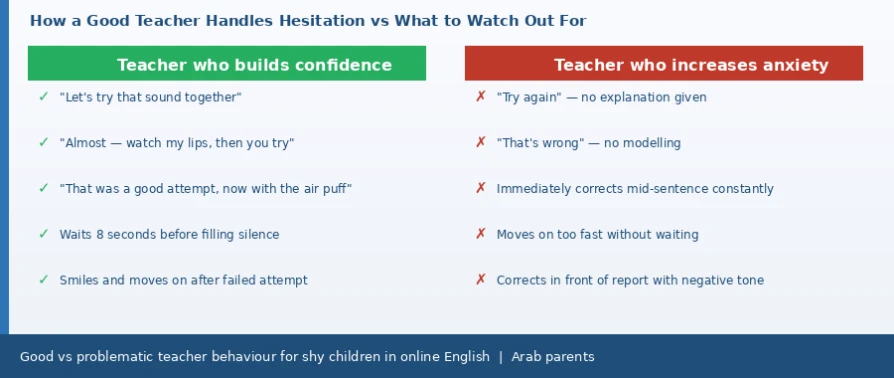
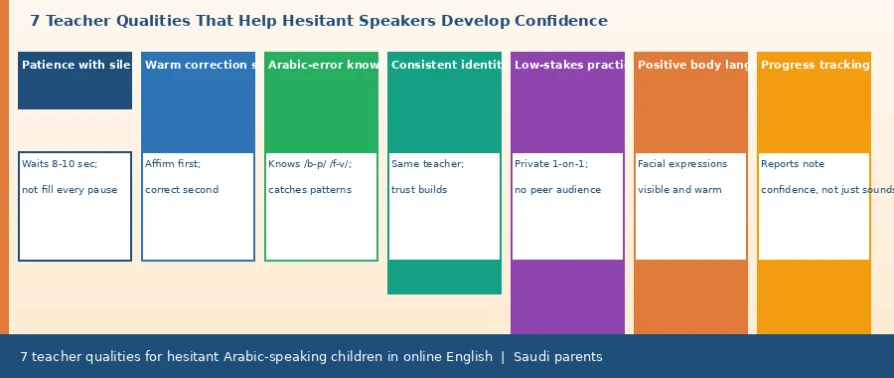
The specific behaviours that matter are: how she responds to silence, whether she affirms the attempt before correcting it, whether she models sounds herself before asking the child to produce them, and whether she treats errors as a normal part of learning or as something to be fixed urgently. These behaviours are not visible in a platform description. They are visible in a trial class.
Questions to Ask Before Booking
| Category | Question | What the answer tells you |
| Teacher background | Has the teacher worked with shy, hesitant, or anxious learners specifically? | A teacher who answers yes with examples is prepared. Vague assurances are not. |
| Arabic experience | Is the teacher familiar with Arabic-English transfer patterns and the specific phonemes Saudi children struggle with? | Without this knowledge, the teacher may not catch the errors that matter most |
| Correction style | Does the teacher affirm the child’s attempt before naming what to correct? | Correction that starts with ‘wrong’ or ‘try again’ increases anxiety for hesitant children |
| Silence handling | How does the teacher respond when a child goes silent for an extended period? | A teacher who waits and then invites builds safety. One who fills every silence builds dependence |
| Gender preference | For daughters: is a female teacher consistently available at preferred time slots? | Comfort matters especially for hesitant children; raise this explicitly |
| Session continuity | Can the same teacher be booked consistently for all sessions? | Trust accumulates; resetting to a new teacher undoes confidence progress |
| Teacher-change policy | What is the process for requesting a different teacher if the initial match is not right? | Know this before it is needed, not after two months with the wrong teacher |
 |
What to Observe During the Trial Class
Apply these five checks to evaluate whether the teacher is the right match for a hesitant child. You can watch a session in person or review the recording if the platform makes it available.
-
Does the teacher wait at least 8 to 10 seconds after asking a question before filling the silence?
-
When the child attempts a sound, does the teacher acknowledge the attempt positively before naming what to adjust?
-
Does the teacher model the target sound herself before asking the child to produce it?
-
Does the child’s body language show any relaxation by the second half of the session?
-
Does the feedback report after the trial note the child’s emotional state, not just language accuracy?
A teacher who scores well on all five is the right fit. A teacher who consistently fills silence, skips affirmation, or moves on after a failed attempt without acknowledgement will not be the right fit regardless of her qualifications.
What a Good Feedback Report Looks Like for a Hesitant Child
For hesitant children specifically, the post-trial feedback report should note more than phonemes. It should describe how the child engaged: did she respond to prompts, attempt sounds when directly invited, show any signs of relaxation during the session? A report that only says ‘/p/ substitution noted; child needs more /v/ work’ is incomplete for this learner profile.
What to look for in the report: a comment on the child’s confidence level during the session, at least one specific moment of successful engagement noted, and a plan for how the teacher will continue building comfort before pushing accuracy. If the report jumps straight to correction targets without noting engagement, the teacher may be optimised for the wrong outcome for this child.
Where 51Talk Fits for Hesitant Learners
What 51Talk is
51Talk is a live one-on-one English platform for children. Sessions are 25 minutes, delivered by qualified teachers, and structured around CEFR levels and Cambridge English learning goals. The lesson cycle includes a pre-class warm-up that activates prior session content, the live lesson, post-class review exercises, a written feedback report, and regular level assessments.
Why the structure supports hesitant children
-
No group audience: mistakes stay private. The public correction shame that shuts down hesitant children in group classes is structurally absent.
-
25-minute format: short enough to stay inside the child’s courage window. The session ends before anxiety peaks.
-
Consistent teacher relationship: booked consistently, the same teacher builds a relationship that hesitant children rely on.
-
Female teacher option: available on request. Ask specifically when booking.
What to confirm before booking for a hesitant child
Ask whether you can request a teacher who specifically has experience with shy or hesitant learners. Ask whether feedback reports include engagement quality, not just phoneme progress. Ask whether the teacher can pace the early sessions primarily around building comfort rather than drilling accuracy. A trial lesson is available at 51talk.com — use it to evaluate teacher warmth before any financial commitment.
What to Do Next
Before booking any teacher for a hesitant child, ask for a trial lesson specifically. State upfront that your child is hesitant about English and ask how the teacher would approach that in the first session. A teacher who gives a specific answer — she would focus on low-stakes activities, model sounds before asking for them, and not push output in session one — is prepared. A teacher who gives a generic answer about being patient and encouraging has not thought specifically about this learner profile.
Save the answers in writing. Compare them to what you observe in the trial. If the trial matches the description, you have found the right teacher. If it does not, you have saved months of the wrong approach before finding out.
Frequently Asked Questions
Can I request a teacher on 51Talk who specifically has experience with shy or hesitant children?
When you enquire about 51Talk, mention that your child is hesitant to speak English and ask whether a teacher with specific experience in that learner profile can be assigned. Ask whether the teacher’s approach includes affirming attempts before correcting and waiting through silences rather than filling them. A trial lesson is available at 51talk.com — use it to evaluate these specific behaviours directly before committing to a plan.
What if the teacher in the trial seems good but my daughter still does not speak?
One non-speaking trial is not a verdict on the teacher. For very hesitant children, the first session may be entirely observational. The question is how the teacher handled the silence. Did she stay warm and patient? Did she invite speech rather than demand it? Did she end the session without the child feeling like she had failed? If yes, book session two. Silent observation is a form of engagement for hesitant children.
My daughter is afraid of being corrected. How do I prepare her for the trial?
Tell her that mistakes are the reason for the lesson, not a problem with the lesson. Frame it as: the teacher is there to help her practise sounds she has not tried before, and trying is the whole point. Getting it right or wrong does not matter in the lesson — trying does. Avoid telling her to ‘do her best’ or ‘not be shy’, which implicitly frames shyness as a failing. Frame the trial as exploration, not performance.
How long should it take before a hesitant child starts attempting sounds without being directly asked?
Most hesitant children show unprompted attempts somewhere between sessions six and twelve with a consistent, warm teacher in a one-on-one format. The key variable is how safe the child feels with the specific teacher. A child who is asked to keep changing teachers will restart the trust-building phase each time, significantly slowing this progression. Consistent teacher booking is not a nice-to-have for hesitant children — it is the core requirement.