Description: A 7-point teacher verification framework for Saudi parents choosing a one-on-one online English teacher for their daughter — covering qualifications, Arabic-learner experience, correction method, feedback quality, and platform policy.
How to Choose an Online English Teacher for Your Daughter:
A 7-Point Verification Checklist for Saudi Parents
Choosing the right online English teacher for your daughter is not the same as choosing the right platform. A platform sets the structure: the session length, the curriculum, the booking system, the feedback format. The teacher determines whether any of that structure actually produces improvement. Two children on the same platform with different teachers can have completely different outcomes, because the teacher is the delivery mechanism for everything the platform promises.
For Saudi parents, the teacher selection carries an additional layer of consideration. The teacher will be working one-on-one with your daughter, which means questions about gender preference, cultural sensitivity, and communication style matter alongside the purely pedagogical ones. A teacher who is technically skilled but makes your daughter feel uncomfortable or self-conscious about her accent will not produce the same results as one who combines correction quality with a warm, respectful teaching manner.
This guide gives Saudi parents a seven-point verification framework for evaluating any online English teacher before committing to a programme. Each point covers what to look for, how to verify it, and why it matters for pronunciation specifically. The guide also includes a platform comparison table, a question bank for the trial class, and a checklist for evaluating the feedback report. It does not prescribe one platform over another but uses 51Talk as a reference point where specific structural features are relevant.
Why the Teacher Matters More Than the Platform
Every online English platform marketed to Saudi parents makes roughly the same claims: qualified teachers, engaging content, measurable progress. The marketing is difficult to evaluate because it describes outcomes rather than mechanisms. What actually determines whether a child improves is not the headline promise but the structural details underneath it: how long each session runs and whether that length fits the child’s attention window, how the teacher and child interact and whether that interaction includes real-time correction, and what happens after the session ends.
This dynamic is especially significant for pronunciation work with Arabic-speaking children. The four most common Arabic-English transfer errors, /b/ for /p/, /f/ for /v/, /sh/ for /ch/, and /d/ or /t/ for /th/, are predictable and well-understood by teachers who have worked with Arabic-speaking learners. A teacher who has worked with Saudi or Gulf Arabic-speaking children knows these patterns and addresses them as a matter of course. A teacher who has not may hear “ben” instead of “pen” and move on without registering it as an error at all.
The platform sets the ceiling. The teacher determines how close to that ceiling the child gets.
The 7-Point Verification Framework
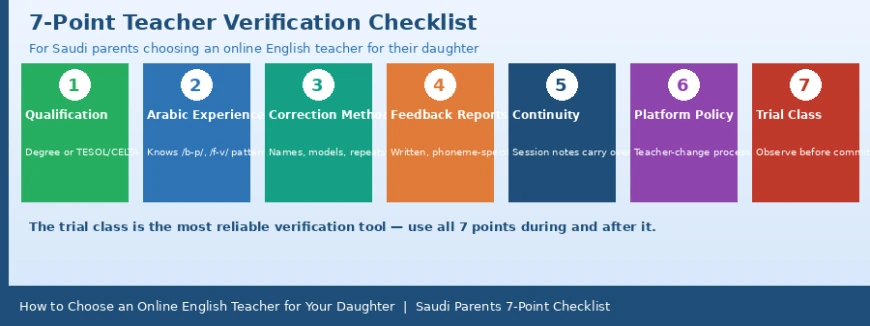
Each point below includes what to look for, how to verify it, and what to conclude from the answer. Work through all seven before making a decision, and treat the trial lesson as the primary verification event.
Point 1: Qualification
A qualified teacher holds either a relevant university degree or a recognised TESOL or CELTA certificate. These are not the same thing. A native English speaker who holds neither has not been formally assessed on teaching methodology, classroom management, or feedback practices. What to ask: does the teacher hold a degree or TESOL/CELTA certificate? Can the platform confirm the qualification on request?
Point 2: Experience with Arabic-Speaking Learners
General teaching experience and experience with Arabic-speaking children are different things. A teacher who has spent three years teaching adult European learners has not encountered the specific phonological transfer patterns that Saudi children produce. What to ask: has the teacher worked with children from Saudi Arabia or other Arabic-speaking backgrounds? Are they familiar with the transfer patterns, specifically /b/ for /p/, /f/ for /v/, and /sh/ for /ch/?
Point 3: Pronunciation Correction Method
This is the most important point for parents whose primary goal is pronunciation improvement. There is a significant difference between a teacher who corrects pronunciation and a teacher who corrects it effectively. The difference lies in whether the correction follows a complete cycle: the error is noticed, the specific sound is named, the correct position is demonstrated, the child is given another attempt, and the attempt is confirmed or adjusted. A teacher who says “try again” without explanation is providing incomplete correction.
Point 4: Feedback Reporting
A written feedback report after each session is the mechanism that connects what happened in the lesson to what the parent does at home and what the teacher does in the next lesson. For pronunciation work, the feedback report needs to name specific phonemes to be actionable. A report that says “/p/ substitution corrected three times; child produced pen and park correctly by end of session” is useful. A report that says “great lesson, worked hard” is not. Ask the platform or teacher for a sample feedback report before enrolling.
Point 5: Session Continuity
Pronunciation improvement is cumulative. A teacher who corrects /p/ substitution on Monday needs to know on Wednesday that /p/ was addressed, whether it improved, and whether it needs further attention. Without carry-over, each session starts fresh and corrections do not compound. What to ask: does the teacher have access to notes from previous sessions before each new lesson begins?
Point 6: Platform Policy
Even a good teacher can be the wrong match for a particular child. Teaching styles vary, and a child who responds well to a warm approach may not engage with a more formal one. The teacher-change process is worth understanding before you enrol. What to ask: what is the process for requesting a different teacher? How quickly can a new teacher be assigned? Is there a cost associated?
Point 7: Trial Class
The trial class is the most reliable verification tool in this entire framework. Every other point can be assessed in advance through questions and sample reports. The trial is the one moment where you see the teacher interact with your daughter in real time. Watch for the full correction cycle: does she notice the error, name the specific sound, model the correct position, and get a repeat attempt before moving on? Note whether your daughter seems comfortable or tense, engaged or distracted.
The 7-Point Checklist at a Glance
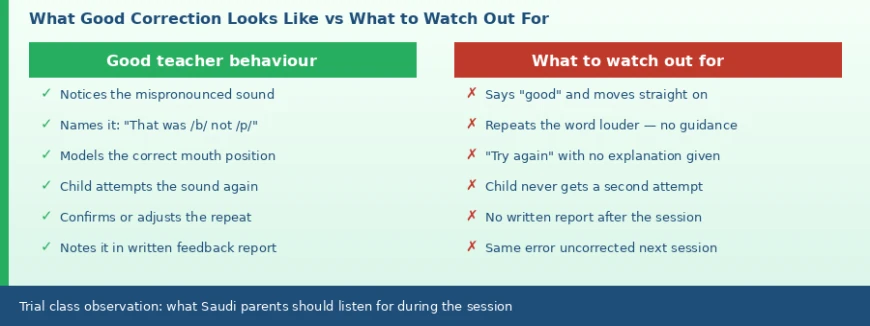
Use this table during and after the trial class. A teacher who satisfies all seven points is worth enrolling with. A teacher who cannot demonstrate Point 3 — the correction cycle — is not suited to pronunciation work regardless of how she performs on the others.
| # | Point | What to ask or observe | Green flag | Red flag | | 1 | Qualification | Does the teacher hold a degree or TESOL/CELTA certificate? | Certificate confirmed by platform on request | No qualification confirmed; vague assurances only | | 2 | Arabic-learner experience | Has the teacher worked with Saudi or Gulf Arabic-speaking children? Does she know /b/ for /p/ and /f/ for /v/? | Specific yes with examples of Arabic-learner patterns | Vague answer about working with diverse students | | 3 | Correction method | When the child mispronounces a sound, does the teacher name it, model the position, and get a repeat? | Full 5-step cycle observed at least once in trial | “Try again” without naming or modelling the sound | | 4 | Feedback reporting | Is a written feedback report provided after every session? Does it name specific phonemes? | Sample report names sounds and describes in-session improvement | Report gives only general comments, no phoneme detail | | 5 | Session continuity | Does the teacher at each session have access to notes from the previous session? | Session notes carry over; teacher confirms this | Each session starts fresh; no carry-over system | | 6 | Platform policy | What is the process for requesting a different teacher? How quickly can it be arranged? | Clear, fast process with no extra cost | Teacher changes difficult, slow, or costly | | 7 | Trial class | Is a trial lesson available before committing? Apply all 6 points above during it. | Trial available; correction quality verifiable directly | No trial; or trial report contains no phoneme detail |
Considerations Specific to Saudi Families and Daughters
Gender preference
Many Saudi families prefer a female teacher for their daughters, whether for reasons of religious observance, cultural comfort, or simple preference. This is a legitimate requirement and should be raised explicitly when enquiring about any platform. Do not assume the platform defaults to female teachers, and do not assume a female teacher is unavailable unless you have asked. Ask specifically: can I request a female teacher for my daughter? What percentage of the teacher pool at my preferred time slots is female?
Cultural sensitivity and communication style
A teacher who understands that correcting a Saudi child is not the same as correcting a child from a European background is more effective. Saudi children may be less accustomed to direct correction in front of peers, more responsive to patient respectful guidance, and more aware of the cultural weight of making mistakes in a second language. A teacher who affirms the child’s attempt before naming what to adjust, who treats each correction as a normal part of learning rather than a failure, is the teacher whose sessions produce confidence alongside accuracy. The trial class is the primary evidence for this. Watch how the teacher responds when your daughter makes an error.
Pronunciation modelling
Some Saudi parents have a preference for a specific accent model. A teacher from the UK and a teacher from the Philippines both deliver qualified English instruction, but their accent models differ. Neither is wrong. What matters more than accent origin is correction accuracy: does the teacher know what standard English pronunciation of /p/, /v/, /ch/, and /sh/ requires, and can they teach it? A non-native speaker of English with strong phonological training may correct Arabic transfer errors more effectively than a native speaker who has never thought explicitly about how the sounds are produced.
Platform Comparison: Teacher-Related Features
This table compares the teacher-related features of three common online English platform types. Use it alongside the 7-point checklist to evaluate specific platforms you are considering.
| Feature | One-on-one programme (e.g. 51Talk) | Group class | On-demand tutoring |
| Teacher sees every production | Yes | Often not | Depends on tutor |
| Arabic transfer errors caught reliably | Yes | Frequently missed | Inconsistent |
| Pronunciation correction documented | Yes (written report) | Rarely | No standard |
| Same teacher across sessions | Yes | Yes | No |
| Female teacher option | Ask platform directly | Depends on school | Browse and choose |
| CEFR-aligned curriculum | Yes | Varies | No curriculum |
| Trial lesson available | Yes | Sometimes | Yes (pay-per-lesson) |
| Teacher-change process | Ask before enrolling | Limited | Easy — new booking |
How 51Talk Addresses Teacher Quality
51Talk is the platform most Saudi parents researching this topic are actively evaluating, so it is worth going through the 7-point framework in relation to what 51Talk offers and what still needs to be confirmed directly.
What 51Talk is
51Talk is a live one-on-one English platform for children. Sessions are 25 minutes, delivered by qualified teachers, structured around CEFR levels and Cambridge English learning goals. The lesson cycle includes a pre-class warm-up, the live session with real-time correction, post-class review exercises targeted to that session’s content, a written teacher feedback report, and regular unit and level assessments.
Points 51Talk addresses at the platform level
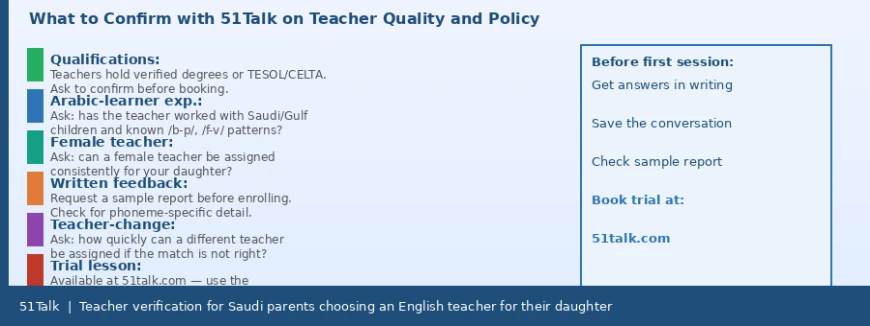
• Qualification. 51Talk teachers are qualified. Verification of specific credentials is available on request. Ask before booking.
• Written feedback report. A feedback report is part of the standard lesson cycle. Ask to see a sample before enrolling and check the level of phoneme-specific detail.
• Session continuity. Session notes carry over between lessons. The teacher at the next session has access to what was covered in the previous one.
• Trial lesson. A trial is available. Use it as the primary verification event. Ask the teacher directly after the trial which sounds she noticed, and read the feedback report specifically for phoneme-level detail. Check details at 51talk.com.
Points you need to confirm directly
• Arabic-learner experience. Ask specifically whether the teacher has worked with Saudi or Gulf Arabic-speaking children and whether she recognises the common Arabic-English transfer patterns. This varies by teacher; ask before booking.
• Female teacher option. Ask whether you can request a female teacher and whether she is consistently available at your preferred time slots.
• Correction method in practice. Whether the teacher completes the full correction cycle depends on the teacher. The trial class is the only way to verify this.
• Teacher-change policy. Ask how quickly a change can be arranged and whether the new teacher receives the previous teacher’s session notes.
Question Bank: What to Ask at Every Stage
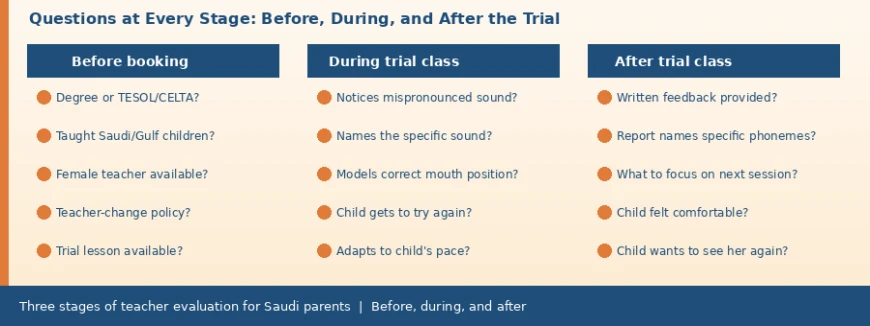
Use these questions in sequence. The before-booking questions can be asked by email or chat. The during-trial and after-trial questions should be observed directly or directed to the teacher.
Before booking
1. Does the teacher hold a degree or TESOL/CELTA certificate?
2. Has the teacher worked with Saudi or Gulf Arabic-speaking children?
3. Is the teacher familiar with Arabic-English transfer errors such as /b/ for /p/ and /f/ for /v/?
4. Can I request a female teacher for my daughter?
5. Is a trial lesson available before committing to the programme?
6. What is the teacher-change process and how quickly can it be arranged?
7. Can I see a sample feedback report before enrolling?
During the trial class
1. Does the teacher notice when the child mispronounces a sound?
2. Does the teacher name the specific sound that was wrong?
3. Does the teacher demonstrate the correct mouth position or air flow?
4. Does the child get another attempt at the same sound in the same session?
5. Does the child appear comfortable and willing to try again after a correction?
After the trial class
1. Was a written feedback report provided?
2. Did the report name specific phonemes that were addressed?
3. What would the teacher focus on in the next session based on today?
4. Did the child want to see the teacher again?
What to Do Next
Work through the seven points before booking anything. Points one and two can be verified by asking the platform before the trial. Point six should be confirmed at the same time. The trial class is where points three, four, and five are verified in practice. Point seven is the trial class itself.
Request a female teacher explicitly if that is your preference. Do not assume. Ask whether the same teacher can be consistently available at your preferred time slots, and ask what happens on a day when that teacher is unavailable. Read the feedback report after the trial with specific attention to phoneme-level detail. If it names sounds, it is a useful feedback system. If it does not, ask whether more detailed reporting is possible before deciding whether to enrol.
The right teacher for your daughter is one who corrects pronunciation completely, communicates respectfully, writes feedback that you can act on, and is consistent session after session. The seven-point framework gives you the questions to find that teacher rather than discover the absence of those qualities three months into a programme.
Frequently Asked Questions
Can I request a female teacher for my daughter on 51Talk, and is the same female teacher consistently available each week?
Female teachers are available on 51Talk. Whether you can consistently book the same female teacher at your preferred time slots across multiple sessions per week depends on the current teacher pool and your local time zone. When you enquire, ask specifically whether a preferred female teacher can be assigned to your daughter’s account as the primary teacher and what happens on days when that teacher is unavailable. A trial lesson is available at 51talk.com to assess both the teacher quality and the booking system in practice.
What if my daughter is too shy to speak during the trial class? Does that mean the teacher is wrong for her?
Not necessarily. Shyness in a first session with a new adult is normal. What to watch for is whether the teacher draws the child out gently rather than pressing her to perform. A teacher who gives the child time, uses low-stakes activities early in the session, and creates a sense of safety before asking for pronunciation attempts is handling shyness well. One quiet trial class is not a disqualifier, but the teacher’s response to the shyness tells you a lot about how she will handle it over the following months.
My daughter has been with the same teacher for two months and her pronunciation has not improved. Is this a teacher problem or a programme problem?
Separate the two. Ask the teacher directly: which specific sounds has she been targeting over the past two months, and have those sounds shown any improvement within sessions? If the teacher cannot answer specifically, the feedback system is not working. If she can answer it but the sounds have not improved, consider whether the home practice between sessions is happening and whether the post-class review is being completed. If both are happening and there is still no improvement, request a different teacher who has specific experience with Arabic transfer errors.
Is a non-native English-speaking teacher as effective as a native speaker for pronunciation correction?
For pronunciation correction specifically, phonological training matters more than native speaker status. A teacher who has been formally trained in how English sounds are produced, who understands the difference between voiced and voiceless consonants, and who knows that Arabic has no /p/ phoneme can correct Arabic transfer errors more effectively than a native speaker who has never thought explicitly about any of those things. When evaluating any teacher, native or non-native, focus on the correction method rather than the accent.
What should I do if the trial class was good but the first few paid sessions feel different?
Address it early. If the teacher who ran the trial is not the same teacher for your ongoing sessions, ask specifically whether the new teacher has access to the trial feedback. If correction quality drops noticeably in paid sessions, flag it with the platform directly and ask whether a different teacher can be assigned. Most platforms including 51Talk have teacher-change processes; knowing how to use them is part of getting the most from the programme.