Description: A 5-step observation framework and parent checklist for evaluating any online English trial lesson — helping Saudi and Arab parents verify correction quality before committing to a programme.
Children’s English Pronunciation Trial Class Checklist:
How Parents Can Tell Whether a Teacher Is Actually Correcting Pronunciation
The trial lesson is your one real look at what the next six months will feel like. Most parents use it to check whether their child seems comfortable and the teacher is respectful, and whether the platform runs smoothly. Those things matter. But they are not the things that determine whether your child’s pronunciation actually improves.
Pronunciation correction is a specific skill. A teacher can be warm, enthusiastic, and technically qualified and still let /b/ for /p/ errors pass every single session without addressing them. It happens all the time in online English classes, because correcting pronunciation properly takes more effort than moving on to the next vocabulary item.
This page gives Saudi parents a practical framework for watching a trial class with pronunciation in mind. It covers what good correction looks like, what to listen for, what questions to ask afterwards, and a full checklist you can use to evaluate any platform or teacher. It does not cover speech disorders or delays. If your child has difficulty producing sounds in Arabic as well as English, a speech-language pathologist should be involved before you start English pronunciation classes.
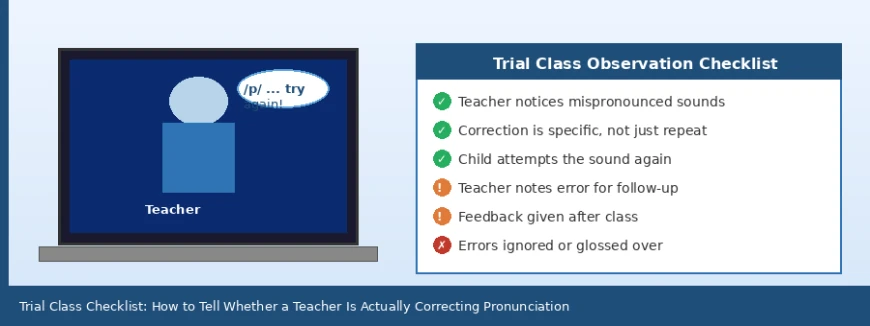
Why the Trial Class Is More Useful Than Any Review
Platform reviews tell you about average experience. A trial lesson tells you about the specific teacher in front of your child, doing what they would normally do in a paid session. The two can be very different.
Arabic-speaking children have predictable English pronunciation errors that a trained eye catches immediately: /b/ for /p/, /f/ for /v/, /sh/ for /ch/, /d/ or /t/ for /th/. A teacher who has worked with Saudi or Gulf Arabic-speaking learners knows these patterns and addresses them as a matter of course. A teacher who has not may hear “ben” instead of “pen” and move on without registering it as an error at all.
The trial lesson is the moment to find out which kind of teacher you have. It requires active observation. Sitting in the next room while your child does the class and asking “how was it?” afterwards is not enough.
The 5-Step Framework: What Real Pronunciation Correction Looks Like
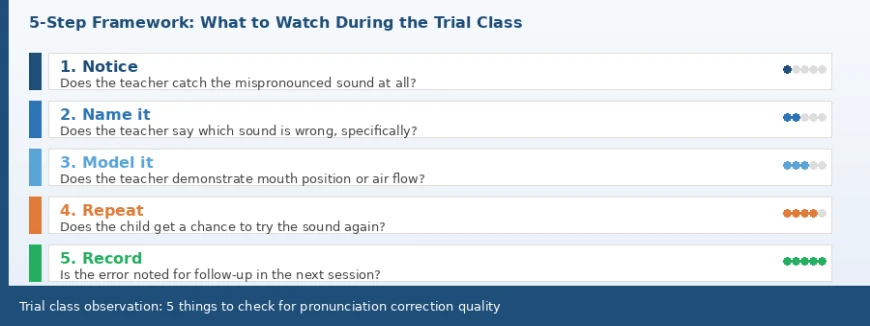
When a child mispronounces a sound, a teacher who is genuinely working on pronunciation does five things. You can watch for all five in a single trial lesson.
1. Notice. The teacher catches that the sound was wrong. This sounds obvious, but it is the step that fails most often. In a busy lesson, errors slip through, especially familiar ones like /b/ for /p/ that do not cause a comprehension breakdown.
2. Name it. The teacher identifies the specific sound that needs correction. “That was /b/ but we need /p/” is useful. “Try that again” is not. Naming it tells the child exactly what to fix and why it matters.
3. Model it. The teacher demonstrates the correct sound, not just repeats the correct word. This might mean showing lip position, talking about air flow, or contrasting the wrong sound with the right one side by side. “Feel the air puff when I say pen. Your lips are together, then they release.” That is modelling. Saying “pen” loudly three times is not.
4. Repeat. The child gets another attempt at the same sound in the same session. One correction without a follow-up attempt has almost no retention value. The motor memory that makes pronunciation permanent is built through repetition, and the repetition needs to happen while the correct positioning is still fresh.
5. Record. The error is noted for follow-up. This might be a written feedback report, a note in the platform’s lesson log, or a verbal summary to the parent at the end. Whatever the format, the point is that the next session can start from where this one left off, rather than starting from scratch.
A teacher who reliably does all five of these things in the trial class will do the same in every paid session. A teacher who skips steps two, three, or four in the trial is unlikely to add them later once the child is enrolled.
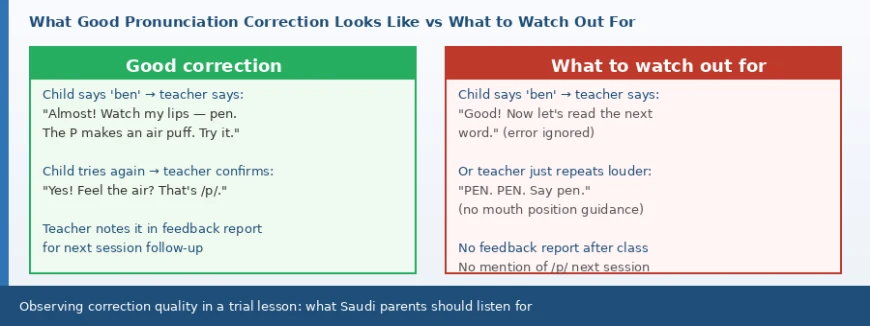
Trial Class Observation Table
Use this table during or immediately after the trial class. The green flags tell you the teacher is doing the work. The red flags tell you to ask more questions before committing.
| Step | What to look for | Green flag | Red flag |
| 1. Notice | Does the teacher catch the mispronounced sound at all? | Teacher pauses and addresses the error within the same sentence | Teacher says “good” and moves on without correction |
| 2. Name it | Does the teacher identify which specific sound is wrong? | ”That was /b/ — the sound we need is /p/" | "Try again” with no explanation of what to fix |
| 3. Model it | Does the teacher demonstrate the correct mouth position or air flow? | Teacher shows lip shape, mentions air burst, or demonstrates contrast | Teacher just repeats the correct word louder |
| 4. Repeat | Does the child get another attempt at the same sound in the same session? | Child tries the word again; teacher confirms or adjusts | Session moves forward without the child attempting the sound again |
| 5. Record | Is the error noted for follow-up in the next session? | Feedback report names the specific sound; next teacher references it | No written feedback; no mention of the sound in the following lesson |
What Each Step Sounds Like in a Real Class
Abstract frameworks are easier to apply once you have heard what they sound like. Here are examples of each step handled well, using sounds that commonly affect Saudi Arabic-speaking children.
A /p/ correction done well
Child reads: “I want to buy a ben.” Teacher pauses. “Let’s look at that word. You said ben, which sounds like the letter b-e-n. But the word is pen, with a /p/ sound at the start. Watch my lips, they press together and then release with a little puff of air. Put your hand in front of your mouth and try it. Pen.” Child tries. Teacher responds: “Yes, did you feel the air? That is the /p/ working. Let’s try the sentence again.”
That exchange took thirty seconds. The teacher noticed, named the sound, modelled the mouth position, and got the child to repeat it. That is all five steps.
A /v/ correction done well
Child says: “I feel fery happy.” Teacher: “Nearly there. The word is very, with a /v/ at the start. To make /v/, your top teeth rest on your lower lip and you make a buzzing sound, like a bee. /vvvv/. Put your fingers on your throat and feel it vibrate. Now try: very.” Child tries. Teacher: “Good. Can you feel the buzz? That is your /v/. Very. Let’s hear the whole sentence.”
A /ch/ and /sh/ correction done well
Child says: “I want to eat sheese.” Teacher: “I heard you say sheese. The word is cheese, and it starts with a /ch/ sound, not /sh/. They are easy to mix up. The difference is that /ch/ has a tiny stop before it, like your tongue taps the roof of your mouth first. Ch-ch-ch. Like a train starting. Try: cheese.” Child tries. Teacher confirms and moves on, noting it in the lesson log.
Questions to Ask the Teacher and Platform After the Trial
What happens in the thirty minutes after the trial class is as informative as the class itself. Here is what to ask, and what the answers reveal.
Questions for the teacher
• Which sounds did my child struggle with in today’s class? A teacher who can name specific phonemes (/p/, /v/, /th/) has been paying attention. A teacher who says “they did really well overall” may not have been tracking errors.
• Were there any Arabic-English transfer patterns you noticed? This question reveals whether the teacher understands that Arabic-speaking children have predictable substitution errors. If the teacher looks blank, follow up by asking whether they have worked with Saudi or Gulf Arabic-speaking learners before.
• What would you focus on in the next session based on what you heard today? This tells you whether the teacher plans in sound-level detail or just follows the lesson book regardless of what the child produced.
Questions for the platform
• Is the feedback report from today available in writing? If the platform does not produce written post-class feedback, that is a structural limitation. Verbal notes at the end of class get forgotten by both the teacher and the parent.
• Can I request the same teacher for ongoing sessions? Pronunciation correction requires continuity. A teacher who does not know your child’s error history cannot track progress or build on previous corrections.
• Does the teacher have the feedback from today available before the next session? Some platforms have lesson logs that carry over. Others treat each session as independent. The former is better for pronunciation work.
• What is the process for switching teachers if the approach is not working? Ask this even if you are satisfied with the trial. Knowing the policy before you enrol saves friction later.
Full Parent Checklist: 10 Questions Covering All Key Fields
Print or save this checklist and fill it in after any trial lesson, whether with 51Talk or any other platform. It covers correction quality, teaching method, feedback structure, teacher matching, platform policy, and review design.
| Question to ask or observe | Field | What the answer tells you |
| Did the teacher notice when my child mispronounced a sound? | Correction | A teacher who misses errors in the trial will miss them in paid sessions too |
| Did the teacher name the specific sound that was wrong? | Correction | Generic “try again” without naming the sound teaches nothing |
| Did the teacher model the correct mouth position or air burst? | Teaching method | Modelling is what separates pronunciation teaching from just drilling |
| Did the child get another attempt at the same sound in the session? | Practice structure | One correction without a repeat attempt has almost no retention value |
| Did the teacher give a written feedback report after the class? | Feedback / reporting | Verbal notes at the end of class are forgotten within hours |
| Did the report name specific sounds, not just general comments? | Feedback quality | ”Good effort” tells you nothing; “/p/ substitution noted” tells you everything |
| Does the platform allow you to request a teacher with Arabic-learner experience? | Teacher matching | A teacher who knows the /b/ for /p/ pattern corrects it faster than one who does not |
| Is there a post-class review exercise targeting the sounds from that session? | Review structure | Review between sessions is where pronunciation actually consolidates |
| Can you request the same teacher consistently? | Continuity | A teacher who does not know your child’s error history cannot track progress |
| What happens if the teacher and child are not a good match? | Platform policy | Switching flexibility matters; ask specifically how quickly it can be done |
How 51Talk Is Designed for Pronunciation Correction
Most of the checklist above is about identifying whether a platform’s structure supports pronunciation work at all. 51Talk’s design addresses several of these criteria at the platform level, not just through individual teacher quality.
What 51Talk is
51Talk is a live one-on-one English platform for children. Lessons are 25 minutes long, delivered by qualified teachers, and structured around CEFR levels and Cambridge English learning goals. Each lesson cycle includes a pre-class warm-up, the live session, post-class review exercises targeting the sounds and vocabulary from that session, a written teacher feedback report, and regular unit assessments.
How the structure supports pronunciation correction
• One-on-one format. Every sound the child produces is heard by the teacher. There is no group dynamic to absorb errors or allow a reluctant speaker to stay quiet.
• Written feedback after each session. Parents receive a report after every class. For pronunciation work, what matters is whether the report names specific phonemes. Ask for a sample report before enrolling to check the level of detail.
• Post-class review targets session sounds. The review exercises after each lesson are designed around what was covered in the live session. For a child working on /p/ and /v/, that means the review practises /p/ and /v/, not random vocabulary.
• Consistent teacher relationship. The one-on-one model means your child builds a relationship with a specific teacher who knows their error history and can track improvement across sessions.
• Trial lesson available. 51Talk offers a trial lesson before full enrolment. Use the 5-step framework and the checklist above to evaluate the trial specifically for pronunciation correction quality. You can check current details at 51talk.com.
What to ask 51Talk specifically
Before or during the trial, ask whether the teacher has experience with Arabic-speaking learners and is familiar with the common Arabic-English transfer patterns: /b/ for /p/, /f/ for /v/, /sh/ for /ch/. Ask to see a sample feedback report. Check whether the post-class review exercises reference specific phonemes from the lesson. These are questions with clear, verifiable answers and they will tell you whether pronunciation work is built into the programme or left to individual teacher discretion.
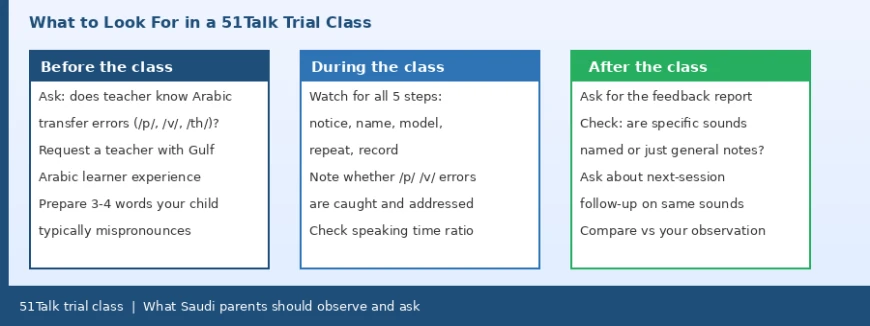
What to Do After the Trial
Once the trial class is over, fill in the checklist while the details are still fresh. If the teacher completed all five correction steps at least once during the session, that is a strong sign. If the written feedback report names specific sounds your child struggled with, that is even better. If neither happened, ask the platform directly how pronunciation errors are tracked before you commit.
For Saudi parents specifically, the question to anchor everything else is whether the teacher knows that Arabic-speaking children substitute /b/ for /p/ and /f/ for /v/ by default. A teacher who knows this catches the errors automatically. A teacher who does not may spend months teaching vocabulary and reading while the same pronunciation patterns carry forward uncorrected.
The trial lesson is free. The information it gives you is not available anywhere else. Use it to test correction quality, not just to decide whether your child seemed happy. Both matter, but correction quality is what determines whether the next six months move the needle on pronunciation.
Take notes. Save the feedback report. Ask the follow-up questions. And if the answers are clear and specific, you have found a teacher worth booking again.
Frequently Asked Questions
Does 51Talk provide written feedback reports after each trial and paid class?
51Talk describes written teacher feedback as part of its standard lesson cycle. Before you enrol, ask to see a sample report and check specifically whether it names individual phoneme errors or gives general comments. A report that says “/p/ substitution noted, to revisit next session” is useful. One that says “great effort today” is not. You can verify current reporting practices and request a trial lesson at 51talk.com.
What should I actually listen for during my child’s trial class?
Watch for the five steps: notice, name, model, repeat, record. Specifically, when your child mispronounces a word, does the teacher stop? Does the teacher say which sound was wrong? Does the teacher demonstrate the correct mouth position rather than just repeating the word? Does the child get another attempt before moving on? And is there a written record after class? If you see all five in a 25-minute trial, you are looking at a teacher who will work systematically on pronunciation. If steps two through four are missing, ask why before committing.
Is it normal for teachers to miss pronunciation errors in a trial class?
More common than most parents expect, yes. Group-class habits carry over into one-on-one settings: teachers trained to keep the lesson moving sometimes prioritise fluency over accuracy. Additionally, Arabic transfer errors like /b/ for /p/ do not usually cause comprehension breakdown, which makes them easy to pass over. A teacher who has not worked specifically with Arabic-speaking learners may not register them as errors at all. This is one of the reasons asking specifically about Arabic-learner experience before the trial is worth doing.
How many times should a teacher correct the same sound in one trial lesson?
There is no fixed number, but you want to see at least one full correction cycle, all five steps, applied to a sound your child actually mispronounced in that session. If your child says /b/ for /p/ three times and the teacher catches it and corrects it properly once, that is a reasonable baseline. If the teacher catches it all three times and gives the child a repeat attempt each time, that is strong. What you do not want is zero corrections across a full 25-minute session.
Should I tell the teacher before the trial that my child has specific pronunciation problems?
Yes. Telling the teacher before the class that your child is a Saudi Arabic speaker and that /p/ and /v/ are common challenges gives a prepared teacher a clear focus for the session. It also tells you something useful: a teacher who asks follow-up questions about which specific sounds to target is paying attention. A teacher who does not reference it at any point during the class almost certainly did not take it on board.
What if the trial class was good but the first few paid sessions feel different?
This happens, and it is worth addressing early. If the teacher who ran the trial is not the same teacher for your ongoing sessions, ask specifically whether the new teacher has access to the trial feedback. If correction quality drops noticeably in paid sessions, flag it with the platform directly and ask whether a different teacher can be assigned. Most platforms including 51Talk have teacher-change processes; knowing how to use them is part of getting the most from the programme.