Your child uses an English app every day. They complete streaks, earn badges, finish levels. Their vocabulary is improving. But when they have to speak English with another person, something shuts down. The words they recognise in the app are not coming out in conversation.
This is the core limitation of app-only English learning. Apps build recognition. Live lessons build production. Recognition is necessary but not sufficient. A child who can identify 500 English words but cannot string three of them into a sentence under social pressure has a production gap that no app can close.
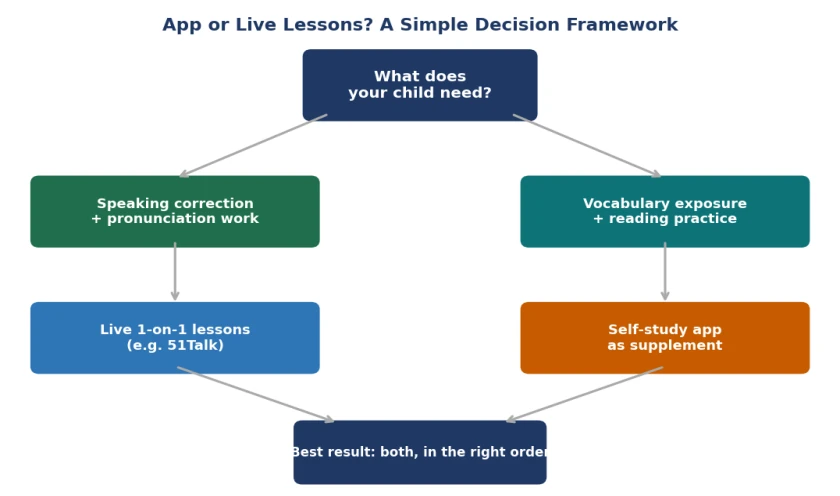
When to choose live lessons, when an app is enough, and when to use both
What Apps Do Well
• Vocabulary building. Spaced repetition, visual association, and game mechanics make apps highly effective at moving words from unfamiliar to recognised.
• Daily habit formation. A three-minute app activity every day is more sustainable for most families than scheduling a live lesson every day.
• Reading and listening practice. Many apps provide high-quality listening passages, reading exercises, and pronunciation audio that children can access independently.
• Low-pressure exposure. For a child who is anxious about speaking, an app provides English input without the social stakes of a live class.
What Apps Cannot Do
• Correct pronunciation errors in real time. An app can mark an answer wrong. It cannot hear that your child said /b/ instead of /p/ and model the correct position.
• Build conversational fluency. Fluency requires responding to unpredictable input from another person. An app’s dialogue trees are predictable and limited.
• Adapt to this child, today. A live teacher who notices that your child seems tired, is stuck on a specific sound, or made unexpected progress adjusts immediately. An app follows its sequence.
• Provide the relational motivation that drives real effort. Children try harder for a teacher they like than for a streak counter.
When to Choose Live Lessons
• Pronunciation correction is needed. If your child has specific sound substitution errors that persist despite exposure, only a live teacher can close that gap.
• Speaking confidence is the goal. Confidence in conversation is built through conversation. Apps do not simulate the actual experience.
• Your child is under 10. Young learners need social interaction and real-time response to build language. App-only learning at this age misses the developmental window for natural language acquisition.
• Progress has stalled on an app. If your child’s app scores keep rising but their spoken English is not improving, they have hit the ceiling of what the format can provide.
Where 51Talk Fits In
What 51Talk is
51Talk is a live one-on-one English platform for children offering 25-minute sessions with qualified teachers, CEFR-aligned curricula, post-class review exercises, teacher feedback, and unit assessments. Try a lesson at 51talk.com.
Why live one-on-one beats app-only for production skills
The specific advantage of 51Talk’s one-on-one format over an app is not that it is more engaging. It is that a teacher hears every word the child produces and can respond to what actually happened rather than what the app predicted would happen. That responsiveness is the mechanism behind pronunciation correction, fluency development, and genuine confidence.
Apps and 51Talk work well in combination. The app builds vocabulary recognition between sessions. The live lesson activates that vocabulary in actual speaking. The review exercises after the lesson reinforce both.
What to keep in mind
Live lessons require scheduling, reliable internet, and a committed family routine. If those conditions are not reliable, an app provides more consistent exposure than sporadic live lessons. The right choice is the one that actually happens consistently.
Before You Enrol: Questions to Ask Any Programme
• What specific skill does this programme target? Match programme to skill gap, not habit.
• Can I combine this with an app? Most live lesson platforms welcome app supplementation.
• What is the minimum effective lesson frequency? Once a week is typically not enough for speaking improvement.
• How does the platform handle missed or cancelled lessons? Consistent attendance matters more than any single lesson.
Frequently Asked Questions
Can 51Talk work alongside an English app like Duolingo?
Yes, and the combination is often more effective than either alone. A daily Duolingo habit builds vocabulary recognition that the 51Talk lesson can then activate in speaking practice. The live session addresses pronunciation and fluency gaps that the app cannot close. Visit 51talk.com for current programme details and a trial lesson.
My child does well on the English app but struggles to speak. Is this normal?
Very common. App performance measures recognition, not production. A child can be excellent at identifying correct answers and still struggle to produce the same words under conversational pressure. This is a production gap, not a knowledge gap. Live speaking practice with a teacher is the direct fix.
At what age should children switch from app-only to live lessons?
The development window for natural-sounding pronunciation closes earlier than most parents expect. Structured live speaking practice is valuable from age 4 or 5 for children learning English as a second language. App-only learning from ages 4 to 8 covers vocabulary but misses the speaking habit formation that becomes harder to build after 10.
What if I cannot afford live lessons every week?
Two live sessions per month with a strong daily app practice between them is more effective than daily app practice alone. Even limited live correction has a disproportionate impact on pronunciation and fluency compared to additional app time. Prioritise frequency of live sessions over session length if the budget is constrained.
What to Do Next
Identify the specific gap: vocabulary recognition, pronunciation, or spoken fluency. If the gap is vocabulary, a strong app may be sufficient. If the gap is pronunciation or fluency, a live programme is needed and an app is a useful supplement. Use the app daily. Schedule live sessions two to three times per week. Take a trial lesson before committing to a package, and use that lesson to confirm the teacher can hear and address your child’s specific errors.